🧑💻 Developer-First #182 - The AI Schism in Software Engineering
When code writes itself, memory becomes infinite, and engineers stop agreeing on what “building software” even means
Hello friend,
A real schism is forming in software engineering between those who have fully embraced AI as their new operating layer, and those who deeply mistrust it. On one side, engineers are prompting instead of typing, delegating execution to models and operating at a higher level of abstraction where intent matters more than syntax. On the other, a growing resistance worries about correctness, security, and the slow erosion of deep system understanding. Both camps have valid points, which is exactly why this tension is not going away quietly.
This week’s edition sits right at the fault line. Skild AI’s massive Series C shows how far AI is pushing into the physical world and real-world execution. Claude Cowork goes one step further, with an internal product reportedly written almost entirely by an AI agent itself. And DeepMind’s Recursive Language Models challenge the very idea of context and memory in AI systems. Different domains, same signal: the way we build, reason about, and trust software is being fundamentally rewritten. The schism is real, it’s accelerating, and it’s only just beginning.
Now, let’s dive into this week’s signals.
P.P.S. If you’re a CTO, VP Engineering, or technical executive, you should join the Unicorn CTO community, a network of European CTOs and technical leaders who learn and connect with peers. You’ll get access to exclusive events and a private Slack group where the top engineering leaders in Europe exchange strategies every week.
Deal of the week — Skild AI raises $1.4B Series C
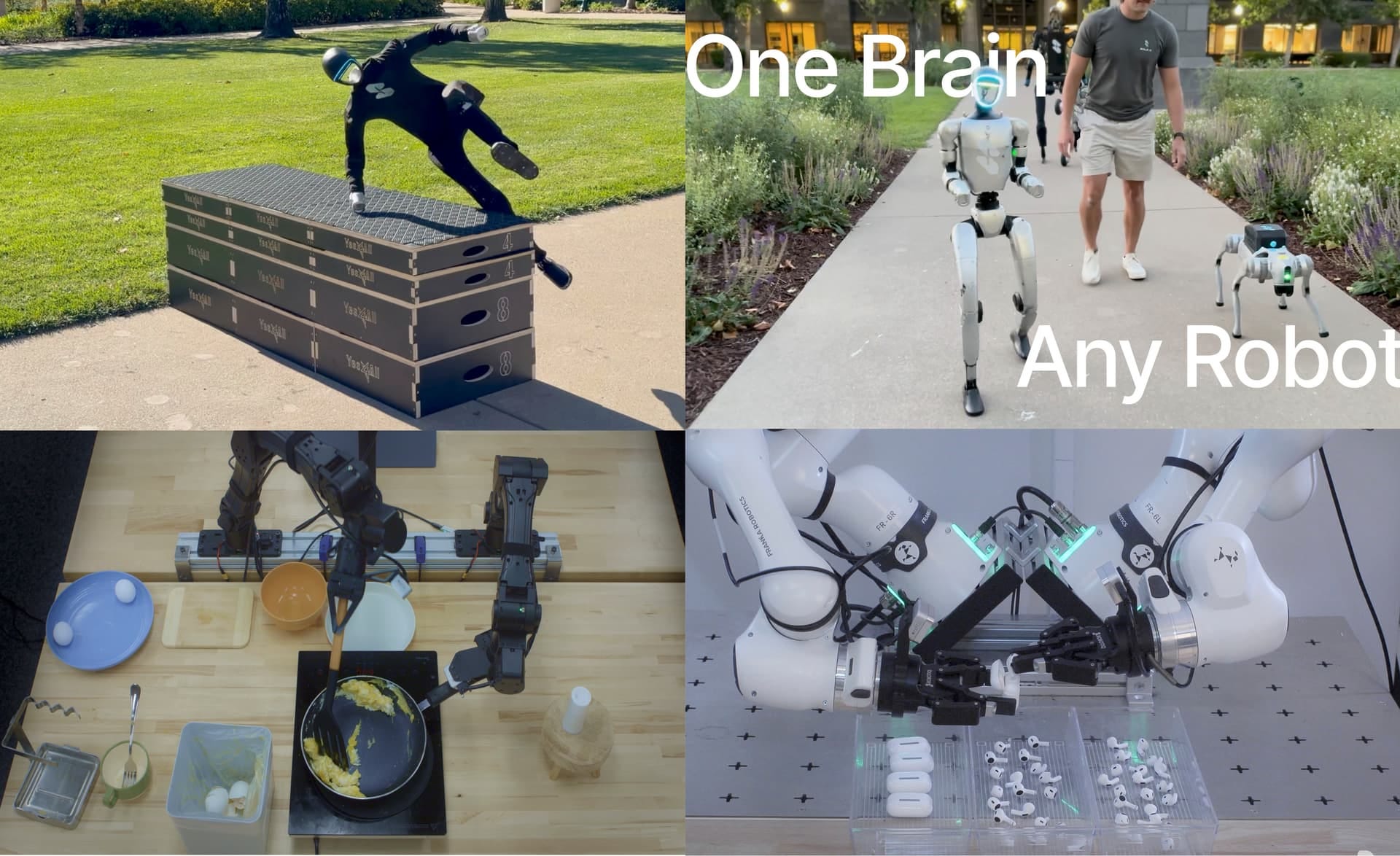
Skild AI just raised a staggering $1.4 billion Series C, led by SoftBank with participation from NVIDIA, Jeff Bezos, and a long list of top-tier financial and strategic investors, pushing its valuation above $14 billion. Founded in 2023, Skild is building what it calls omni-bodied intelligence: a single, general-purpose AI brain capable of controlling any robot, across tasks and hardware, without being re-engineered each time.
Instead of bespoke robotics stacks, Skild is betting on a unified robotics foundation model trained through a massive data flywheel: large-scale simulation, internet videos of human actions, teleoperation data, and real-world deployments. That bet is already paying off commercially, with revenue reportedly jumping from zero to ~$30M in just a few months in 2025, across sectors like security, construction, warehouses, and industrial environments.
💭 My take: This round confirms that embodied AI is one of the hottest frontiers right now, and not just in Silicon Valley. The timing is striking, especially in France, where Yann LeCun just launched Advanced Machine Intelligence to focus on AI systems that understand physical reality, and recently backed Universal Mechanical Assistant, another push toward general-purpose robotics. Read more about this deal here. Also, you’ll find all the other transactions from last week in The Changelog at the end of this newsletter.
Claude Cowork: when AI starts building
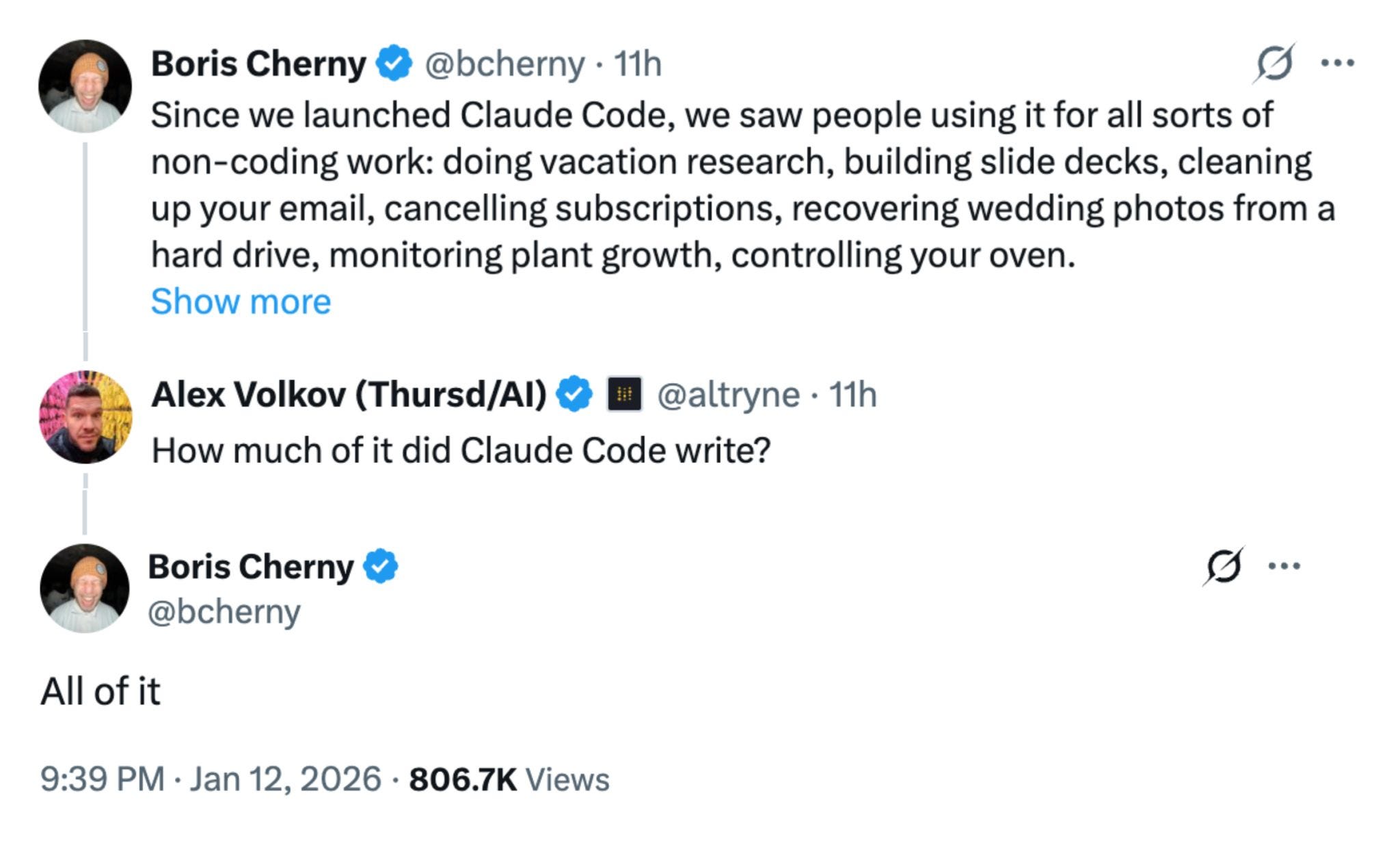
Last week, Anthropic quietly crossed a line with the release of Claude Cowork, a new agentic mode for Claude. Claude Cowork can work inside a local folder (via Claude Desktop on macOS), create and edit files, organise documents, and execute multi-step tasks end to end, from research to synthesis to delivery.
What makes this release truly notable is how it was built. According to Boris Cherny, Head of Claude Code at Anthropic, the entire Claude Cowork codebase was written by Claude Code itself. Not assisted. Written. His own setup runs multiple Claude agents in parallel, coordinated through hooks, working continuously for minutes, hours, sometimes days. The numbers are staggering: hundreds of PRs, thousands of commits, tens of thousands of lines added and removed, all generated by Claude. This is not autocomplete, and it’s not prompt-to-snippet coding. It’s AI operating as a persistent engineering system.
The real shift here isn’t speed, it’s mode of operation. Claude isn’t producing isolated answers; it’s holding context, iterating, and shipping. Humans define intent, constraints, and guardrails, and the AI executes. This only works today in specific conditions, mostly greenfield projects with clear direction, but the trajectory is unmistakable. Claude Cowork isn’t a gimmick. It’s a preview of a world where software development moves from humans writing code with AI assistance to humans designing systems while AI does the bulk of the execution, faster than most organisations are ready to admit.
DeepMind’s Recursive Language Models: memory without context windows
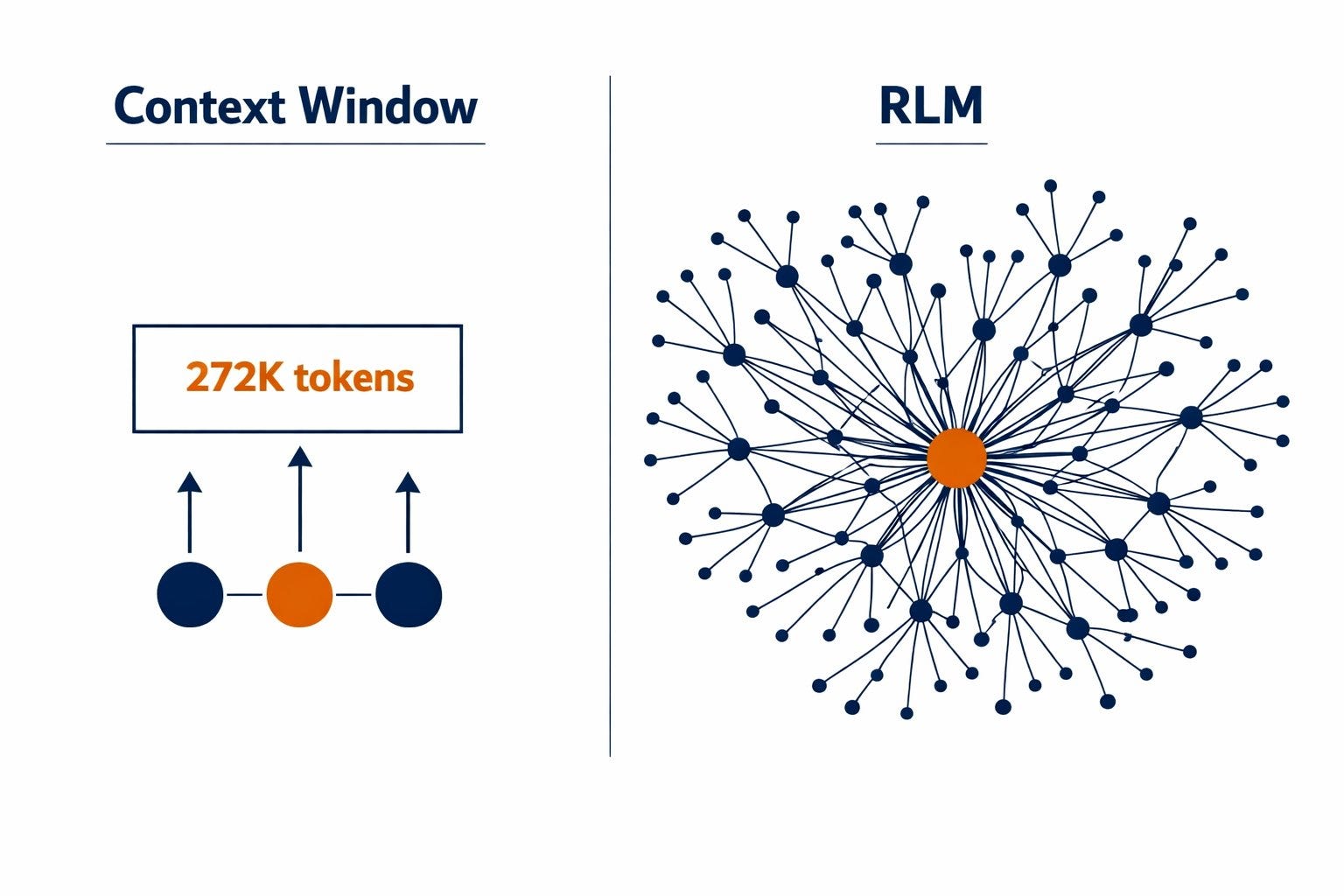
DeepMind just challenged one of the most deeply held assumptions in LLM design: that the path forward is ever-larger context windows or increasingly complex RAG pipelines. Recursive Language Models (RLMs) take a radically different approach. Instead of stuffing massive documents into a prompt, the model is placed inside an execution environment, like a Python REPL, where the prompt becomes a variable it can programmatically explore. The model writes code to search, slice, and recursively call itself on only the relevant parts of the data.
The results are not incremental, they’re qualitative. On multi-document research tasks, base models effectively score zero because the information simply doesn’t fit; with RLMs, performance jumps above 90%. On dense reasoning tasks, accuracy moves from near-random to genuinely useful. Crucially, this isn’t a new model or special training regime: the same frontier models, including GPT-5 and Qwen3-Coder, discovered recursive strategies on their own when given the right tools. The real implication is unsettling and exciting at the same time: the future of “long-term memory” in AI may have little to do with bigger context windows, and everything to do with letting models actively navigate unbounded information. The original paper is worth reading in full:
The Changelog - Week of January 12th, 2025
Last week, 11 companies raised $2.07 billion in 4 countries. Europe-based companies attracted 0.3% of total funding vs 98% for North America-based companies and 1.7% for Asia-based companies (incl. Israel). One of these companies distribute or contribute to an open-source project. On the M&A side, 2 companies were acquired.
Funding Rounds
Skild AI, from Pittsburgh 🇺🇸 raised $1.4 billion in Series C funding led by SoftBank. Skild AI builds general-purpose AI software for robots and humanoid systems, enabling autonomous physical intelligence. (more)
ClickHouse, from Palo Alto 🇺🇸 raised $400 million in Series D funding led by Dragoneer Investment Group. ClickHouse provides a real-time analytics database powering high-performance analytics and AI workloads. (more)
Deepgram, from San Francisco 🇺🇸 raised $130 million in Series C funding led by AVP. Deepgram builds voice AI models for speech recognition and text-to-speech applications. (more)
webAI, from Austin 🇺🇸 raised Series A funding led by Time Ventures at a $2.5 billion valuation. webAI develops privacy-focused AI software enabling sovereign AI models to run securely on user devices. (more)
Cast AI, from Miami 🇺🇸 raised Growth funding led by Pacific Alliance Ventures at a $1 billion valuation. Cast AI offers an ML-driven optimisation platform for Kubernetes cost, performance, and security, now expanding into GPU resource management. (more)
Wasabi Technologies, from Boston 🇺🇸 raised $70 million in Growth funding led by L2 Point Management. Wasabi provides a high-performance, cost-efficient cloud object storage platform for data infrastructure. (more)
Depthfirst, from San Francisco 🇺🇸 raised $40 million in Series A funding led by Accel. Depthfirst scans and analyzes codebases to identify and remediate security risks across complex software systems. (more)
IO River, from Tel Aviv 🇮🇱 raised $20 million in Series A funding led by Venture Guides. IO River provides a virtualisation layer that allows developers to run edge and content delivery services across multiple networks seamlessly. (more)
VoiceRun, from Cambridge 🇺🇸 raised $5.5 million in Seed funding led by Flybridge Capital. VoiceRun offers a developer platform to build, test, and deploy AI-powered voice agents. (more)
Modeinspect, from Prague 🇨🇿 raised $3.4 million in Seed funding led by Partech. Modeinspect lets designers edit live production products the same way developers edit code, bridging design and engineering workflows. (more)
Bricks.sh, from Milan 🇮🇹 raised $1.9 million in Pre-Seed funding led by Primo Capital. Bricks.sh uses AI to automatically generate and maintain internal admin tools directly from APIs and databases. (more)
M&A Transactions
LangFuse, from Berlin 🇩🇪 was acquired by ClickHouse. LangFuse is an open-source LLM engineering platform designed to help developers monitor, debug, and improve AI applications. (more)
Human Native, from London 🇬🇧 was acquired by Cloudflare. Human Native operates an AI data marketplace enabling paid and traceable data exchanges between content creators and AI developers. (more)
I’m rethinking this newsletter’s structure for 2026 and I wanted your opinion on the ChangeLog section. More specifically, I want to know if you’re using this section to have access to ALL transactions, or you’re just interested by the top transactions.