🧑💻 Developer-First #169 - After Software ate the world, will AI eat Software?
Bain & Company’s 2025 Tech Report outlines four scenarios for SaaS

Hello friend,
Twenty-five years after SaaS reshaped the IT industry, the model that once defined software is facing its own existential disruption. According to Bain & Company’s Technology Report 2025, AI agents are no longer just assistants; they are starting to replace entire workflows.
👉 Code writing (Cursor)
👉 Ticket management (ServiceNow)
👉 Accounting (Workday)
👉 Copywriting (Adobe)
In the span of just a few years, many repetitive processes could shift from “human + app” to “AI agent + API.”
Bain identifies four strategic scenarios for SaaS vendors navigating this transition 👇
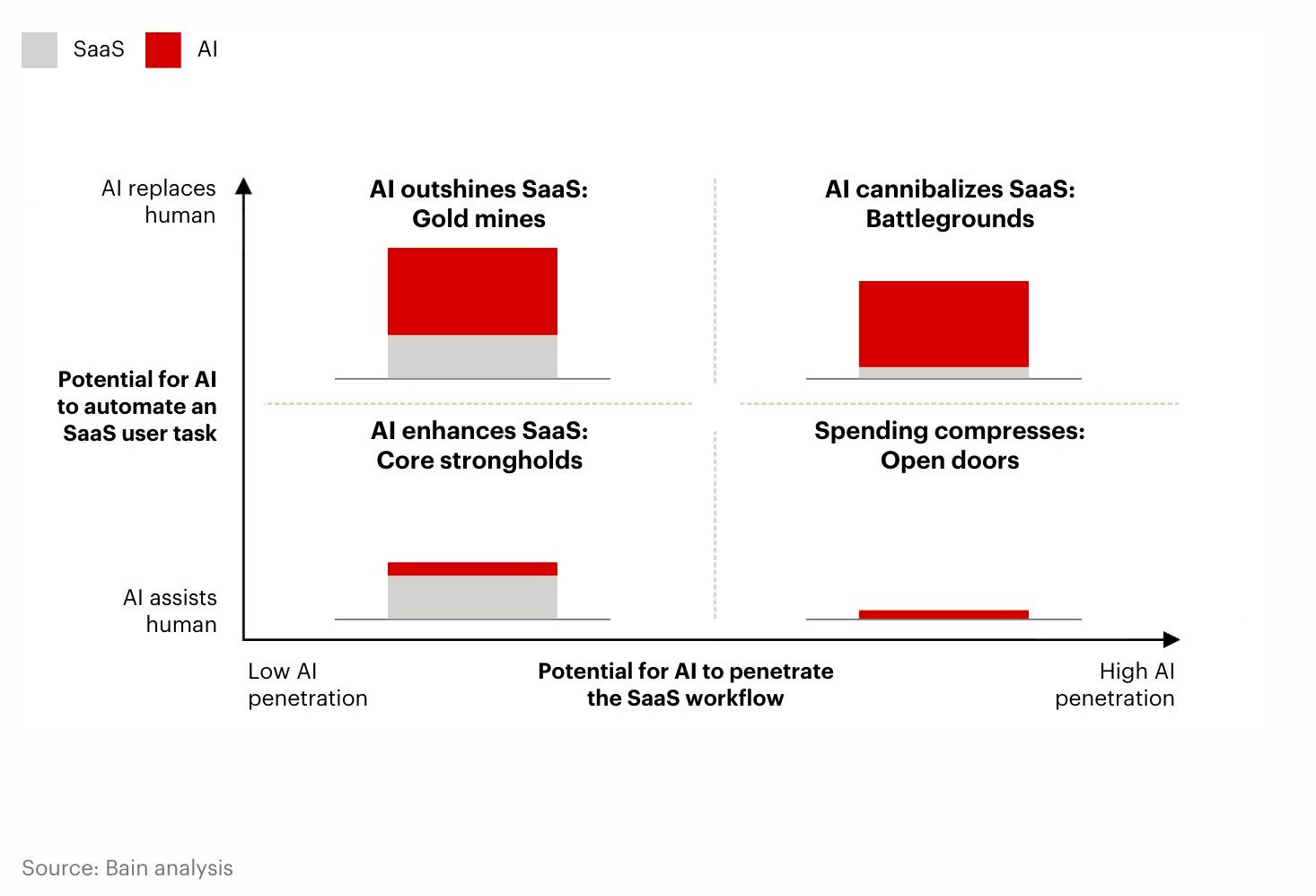
1️⃣ Core Strongholds – AI reinforces existing SaaS, strengthening value for incumbents.
2️⃣ Open Doors – AI compresses software spend, especially where APIs are too open.
3️⃣ Gold Mines – AI surpasses SaaS, creating new sources of growth.
4️⃣ Battlegrounds – AI cannibalizes SaaS, triggering full-blown disruption.
To stay competitive, SaaS providers will need to:
Own the data, which remains their most defensible moat.
Lead on standards, especially around agent interoperability.
Rethink pricing, moving from per-user models to outcome-based pricing.
Deeply integrate AI, shifting products from “do it yourself” to “do it for me.”
📌 The bottom line: AI is reshuffling the deck, but obsolescence is not inevitable. SaaS leaders that move fast can turn disruption into leverage, and even write the next chapter of the industry.
Deal of the week - Nscale raises $1.1B Series B — the largest in European history
The AI race just delivered another European milestone. After ASML’s €1.3B bet on Mistral AI two weeks ago (see here), UK-based Nscale has closed a $1.1B Series B to scale its GPU-powered AI infrastructure globally. The round was led by Aker ASA, with participation from Nokia, NVIDIA, and others, and values Nscale at $11.7B.
Like the ASML–Mistral deal, Nscale’s raise is framed as a sovereignty play: building a European alternative to US hyperscalers by anchoring sovereign data centres in low-cost renewable hubs. Together, these two mega-deals mark a turning point: Europe may finally begin to shape its own AI-industrial strategy.
Read more about this deal here. Also, you’ll find all the other transactions from last week in The Changelog at the end of this newsletter.
Market pulse - Accenture’s $865M “reinvention”
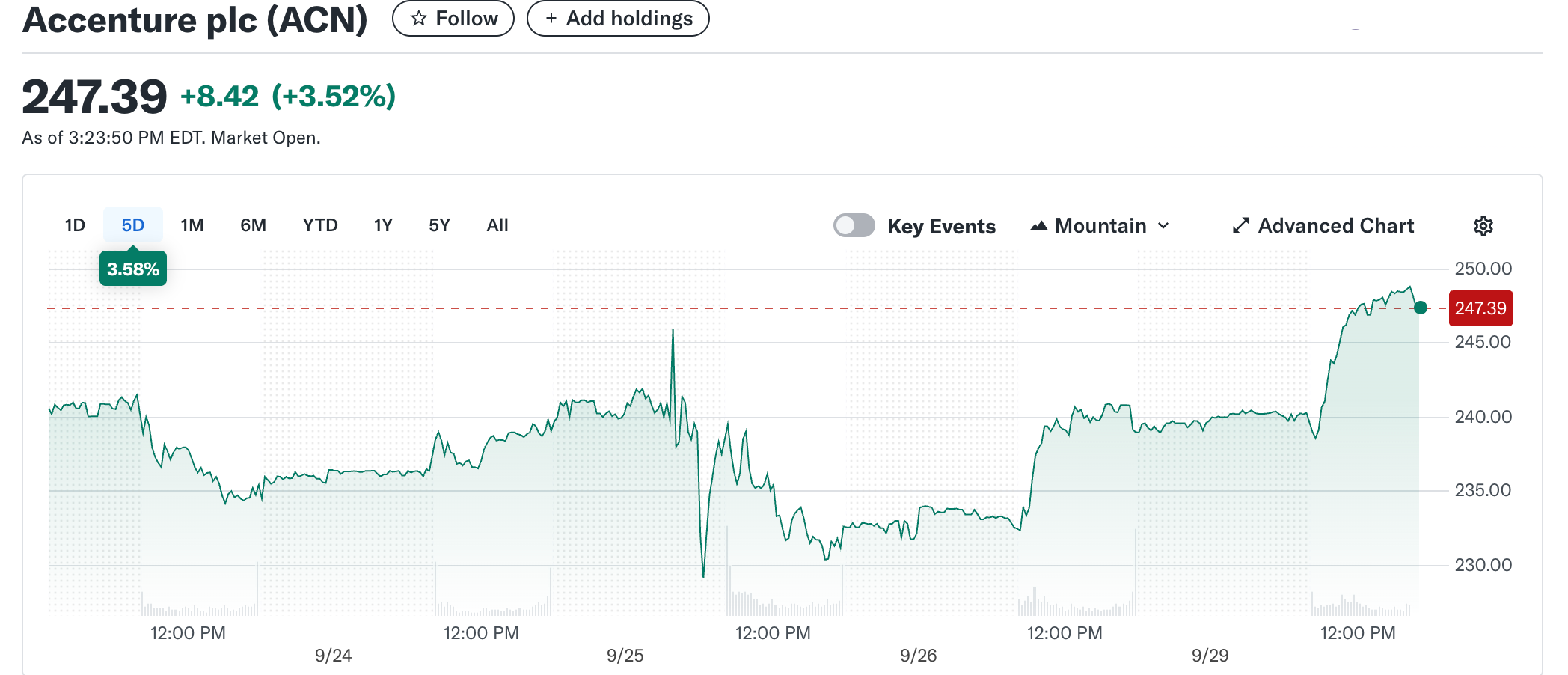
Accenture has announced a six-month, $865 million restructuring program to align itself with an AI and digital-driven future. About $615 million has already been booked in Q4 for severance, impairments, and divestitures, with another $250 million to follow in the new fiscal year. The plan is blunt: exit staff who can’t be reskilled, redeploy resources toward AI and digital talent, and divest noncore businesses. Headcount has already dropped by ~11,000 in three months, though management expects it to rise again in FY 2026 with new AI-focused hires.
The market reaction was mixed. Despite beating Q4 earnings and revenue estimates, shares initially slipped, with some reports citing a ~3% drop on cautious forward guidance. But the stock has since stabilised, reflecting investor recognition that this is less about utilisation cuts and more about a workforce reset for the AI era.
Signals vs Noise - The open-source deep research boom
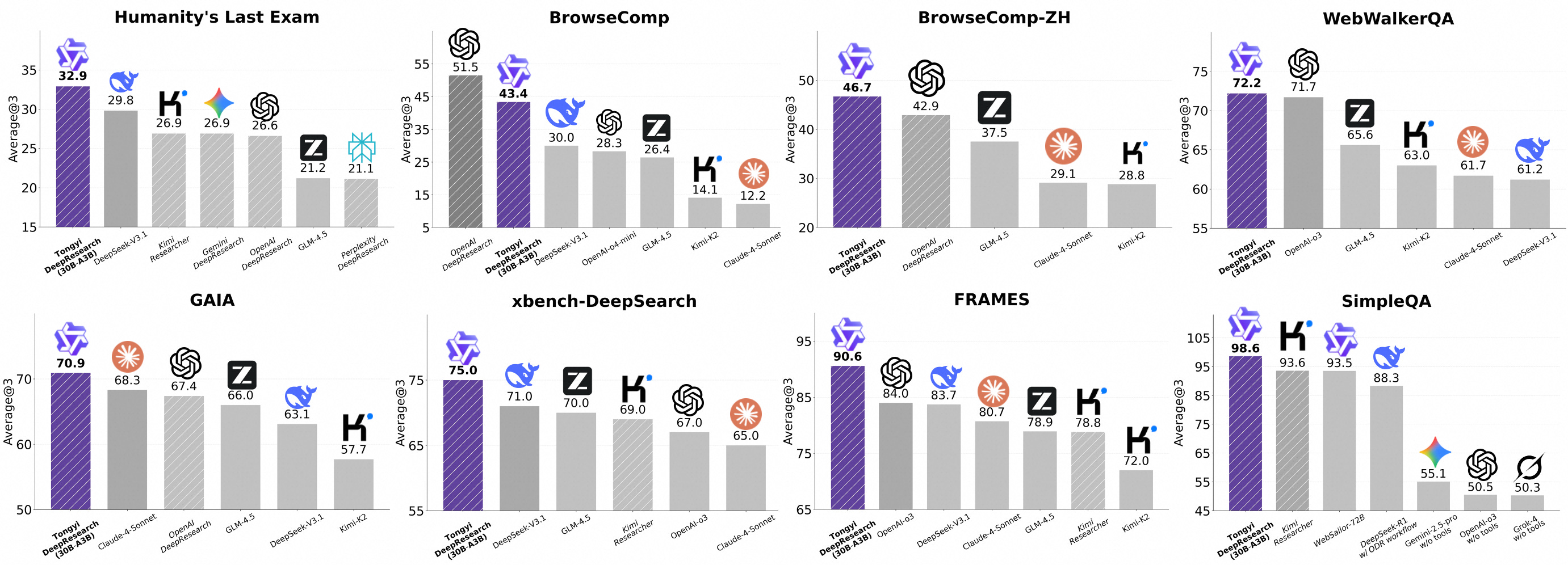
This fall seems to be all about deep research agents, and open-source projects are exploding in popularity. The standout is Tongyi DeepResearch (Alibaba, 15.1k stars), an agentic LLM designed for long-horizon information-seeking. With 30.5B parameters (only 3.3B activated per token), it has topped GitHub’s trending charts and is setting benchmarks across BrowserComp, Humanity’s Last Exam, and other agentic search tasks.
But Alibaba isn’t alone. Open Deep Research (David Zhang, 17.8k stars) has become the most starred implementation, offering a simple agent that iteratively refines its research direction using search + scraping. LangChain’s version (9k stars) adds configurability across models, search tools, and MCP servers.
The signal is clear: deep research has emerged as the first breakout “agent-native” application, and right now, the momentum is almost entirely US- and China-led. For Europe, the absence of visible open-source players in this wave highlights the urgency of building sovereign alternatives before defaults are set elsewhere.
The Changelog - Week of September 22nd, 2025
Last week, 17 companies raised $1.85 billion across 7 product categories in 5 countries. Europe-based companies attracted 61% of the total funding vs 37% for North America-based companies and 2% for Asia-based companies. Three of these companies distribute or contribute to an open-source project. On the M&A side, 0 companies were acquired.
Funding Rounds
Nscale, from London 🇬🇧 raised Series B funding led by Aker ASA. Nscale is a European hyperscaler engineered for AI, offering vertically integrated infrastructure optimized for training, fine-tuning, and intensive workloads. (more)
Modular, from Palo Alto 🇺🇸 raised Series B funding led by US Innovative Technology Fund. Modular is building a next-generation AI developer platform unifying the development and deployment of AI. (more)
Distyl AI, from San Francisco 🇺🇸 raised Series B funding led by Khosla Ventures and Lightspeed Venture Partners. Distyl AI’s enterprise platform, Distillery, curates context across organizations to drive measurable outcomes quickly. (more)
Cohere, from Toronto 🇨🇦 raised Late VC funding from Business Development Bank of Canada ND and Nexxus Capital Management. Cohere builds enterprise-grade AI models with deployment options across cloud, private cloud, and on-prem environments. (more)
Factory, from San Francisco 🇺🇸 raised Series B funding led by New Enterprise Associates. Factory develops AI-powered software agents bringing autonomy to software engineering. (more)
Obot AI, from Cupertino 🇺🇸 raised Seed funding co-led by Mayfield Fund and Nexus Venture Partners. Obot AI is building an open-source LLM stack for enterprises to run private AI services on internal data and apps. (more)
Flox, from New York 🇺🇸 raised Series B funding led by Addition. Flox enables reproducible development environments across the entire software lifecycle. (more)
Greptile, from San Francisco 🇺🇸 raised Series A funding led by Benchmark. Greptile is an AI expert for codebases, helping developers search, refactor, and debug through natural language. (more)
Emergent, from Bangalore 🇮🇳 raised Series A funding led by Lightspeed Venture Partners. Emergent builds autonomous coding agents that transform plain-language ideas into fully functional applications. (more)
Synthesized, from London 🇬🇧 raised Series A funding led by Redalpine. Synthesized delivers AI-native test automation to eliminate test data bottlenecks for enterprises. (more)
Rocket.new, from Surat 🇮🇳 raised Seed funding led by Salesforce Ventures. Rocket generates production-ready applications from a single prompt, accelerating software creation. (more)
InCountry, from San Francisco 🇺🇸 raised Series A funding led by Arbor Ventures. InCountry enables SaaS apps to process and store regulated data locally, ensuring compliance. (more)
Testkube, from Wilmington 🇺🇸 raised Series A funding led by Ratmir Timashev. Testkube is a Kubernetes-native testing framework that simplifies cloud-native test automation. (more)
VeeZoo, from Zurich 🇨🇭 raised Series A funding led by ACE Ventures. Veezoo provides a chat-based analytics platform that generates insights and visualizations directly from plain-English queries. (more)
Scorecard, from Stoughton 🇺🇸 raised Seed funding led by Kindred Ventures. Scorecard is an evaluation platform for testing and deploying AI and LLM applications. (more)
Trismik, from Cambridge 🇬🇧 raised Pre-Seed funding led by Twinpath Ventures. Trismik provides a science-grade experimentation platform for rapid LLM evaluation. (more)
Ardent AI, from New York 🇺🇸 raised Pre-Seed funding led by Crane Venture Partners. Ardent AI accelerates data engineering tasks with 100x performance improvements. (more)