🧑💻 Developer-First #194 - AI bottlenecks
It's not just about using AI, but how to deploy, integrate and manage its output
Hello friend,
AI is not reducing the importance of software engineering, it is changing where the difficulty lives.
On one side, companies are accelerating software production at unprecedented speed. AI coding agents can now generate features, products, and workflows in days instead of months. Founders are shipping products without traditional engineering teams. Enterprises are seriously questioning whether they should buy software or rebuild it internally with AI. And model providers like OpenAI and Anthropic are moving aggressively into enterprise deployment because they understand that the real value is no longer the model itself, but the operational layer around it.
But at the same time, the industry is starting to hit a new wall. Codebases generated rapidly by AI are becoming harder to reason about, maintain, and evolve. Teams are discovering that while AI dramatically reduces execution friction, it also accelerates architectural entropy. Chat interfaces collapse under system complexity. Humans cannot realistically review millions of lines of AI-generated code manually. And companies are slowly realising that generating software is not the same thing as understanding systems. That is why the real bottleneck is shifting from code production to system comprehension.
Now, let’s dive into this week’s signals.
P.S.: I recently launched Rubbr, a controlled AI-driven software delivery platform for legacy systems. If you’re interested in talking about AI engineering in real-life setups, let’s talk!
Frontier labs are becoming AI Integrators
Anthropic and OpenAI both announced major enterprise AI deployment ventures backed by some of the world’s largest private equity firms. Anthropic partnered with Blackstone, Hellman & Friedman, Goldman Sachs and others in a new $1.5B deployment structure designed to integrate Claude deeply inside enterprises through workflow redesign, internal agents, and long-term operational support. OpenAI reportedly launched a similar entity called “The Deployment Company,” backed by firms including TPG, Brookfield, Bain, and SoftBank, with plans to embed engineers inside enterprises and even acquire consulting firms. In practice, both companies are moving far beyond selling APIs or chat interfaces. They are positioning themselves as full-stack AI transformation companies, closer to a mix of Palantir, Accenture, and AWS Professional Services powered by frontier models.
I think this is one of the strongest signals yet that real AI adoption is fundamentally an integration and deployment problem, not a model problem. Most enterprises already have access to GPT, Claude, Gemini, and increasingly capable open-source models. The hard part is redesigning workflows, integrating AI safely into legacy systems, orchestrating agents, and changing how organisations operate. If frontier labs are moving directly into services, it’s likely because they know they cannot rely entirely on traditional integrators, either because many consulting firms still lack deep AI deployment expertise, or because true AI-native transformation threatens their historical business models built around large human delivery organisations. And this dynamic won’t stop at model providers. Every serious AI company will eventually face the same reality: selling the model is easy, operationalising it inside enterprises is where the real value (and the real moat) sits.
Beyond chat: the next interface for software development

The same shift is coming to software delivery platforms. Conversational interfaces are incredibly effective for brainstorming, debugging, and writing requirements, but they break down when managing complex software systems over time. As AI increasingly writes the code itself, the IDE becomes less central, while infinite streams of chat become harder for humans to reason about. Teams start skimming, architecture drifts, and after a few hours nobody is fully sure whether the agent is still following the original system design or improvising. My view is that the next generation of software delivery platforms will be visual first, chat second: diagrams, flows, state maps, and system representations that humans can reason about intuitively, with conversation acting as a supporting layer rather than the primary interface.
The comments on my related LinkedIn post strongly reinforced this idea. Several practitioners argued that the real challenge is no longer code generation itself, but understanding what agents are doing across increasingly complex systems. Others pointed out that chat collapses non-linear systems into linear conversations, making coordination and architecture tracking extremely difficult at scale. Multiple commenters highlighted that the “diagram as source of truth” is already emerging in agentic workflows, with code becoming more like a serialization of a higher-level system graph. There was also an interesting consensus that humans and AI may ultimately require different interfaces altogether: structured machine-readable layers for agents, and visual abstractions for humans.
The Coming wave of AI-native technical debt
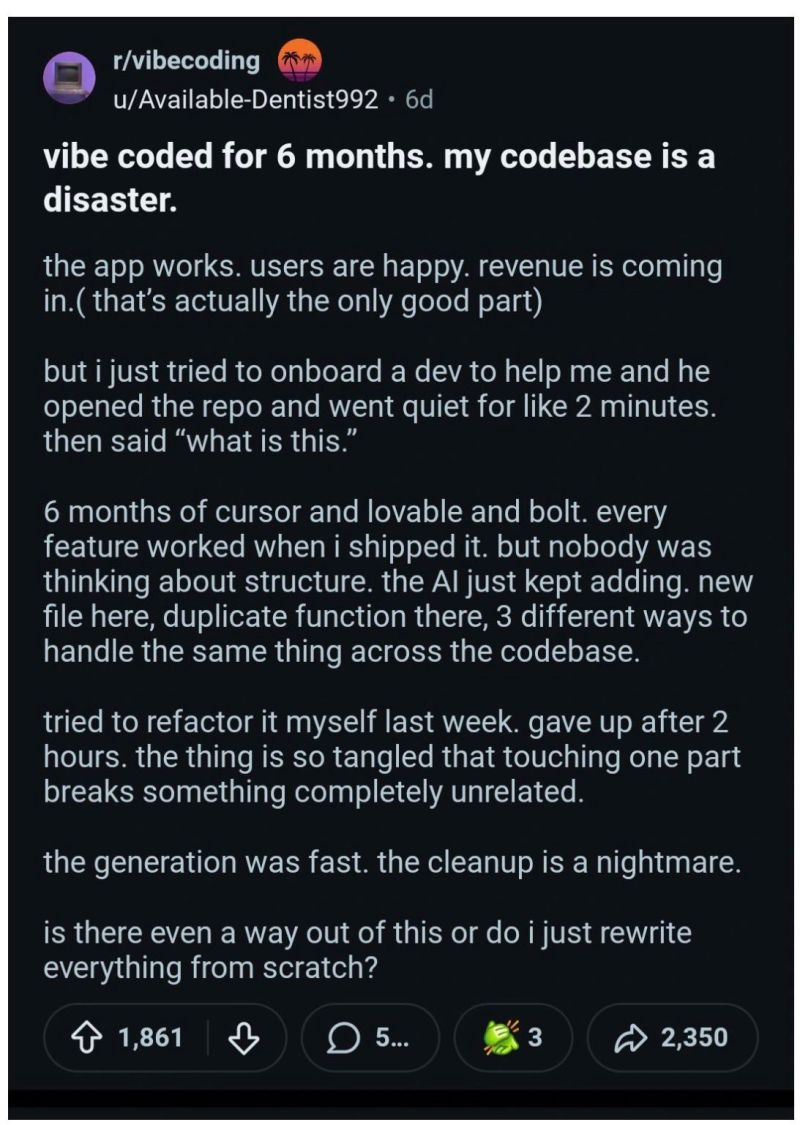
The situation described in this viral Reddit post is likely to become the norm, not the exception. As long as products solve real business problems and generate revenue, teams will continue doubling down on AI-generated code because the short-term leverage is simply too powerful. But this is not just a “non-programmer vibe coder” problem. Professional developers face the same drift over time because most AI coding agents are optimised for rapid code generation, not for preserving architecture or long-term system coherence. After enough iterations, codebases gradually diverge from the original plan. My main point was that the proposed solution (having humans manually review and refactor massive amounts of AI-generated code) does not scale. Instead, we will need AI-native software delivery platforms capable of understanding, governing, refactoring, and evolving AI-generated systems continuously over time.
The comments to my post strongly reflected both the anxiety and inevitability surrounding this shift. Many engineers agreed that current coding agents behave like “entropy creation machines,” continuously adding code while rarely simplifying or removing complexity. Others pointed out that this problem already existed with human-written software, but that AI massively accelerates the accumulation of technical debt. Several practitioners observed that the real challenge is not generation, but architectural consistency across thousands of rapidly produced changes. Some argued that stricter engineering discipline, better specifications, smaller PRs, and stronger testing practices could mitigate the issue, while others believed new AI tooling would emerge specifically to maintain and refactor AI-native systems automatically. The industry is increasingly confronting a new reality: when code generation becomes abundant, the scarce resource becomes system coherence.
The Changelog - Week of May 11th, 2026
Last week, 5 companies raised $1.99 billion in 4 countries, including $1.3 billion just for North America-based Amp. Europe-based companies attracted 33% of total funding vs 67% for North America-based companies. None of these companies distribute or contribute to an open-source project. On the M&A side, 1 company was acquired.
Funding Rounds
Amp, from Menlo Park 🇺🇸, raised $1.3 billion in Seed funding led by Andreessen Horowitz and Y Combinator. Amp is an AI compute pooling platform that aggregates GPU capacity from data center operators and makes it accessible to startups, universities, and other organisations. (more)
Judgment Labs, from San Francisco 🇺🇸, raised $32 million in Series A funding led by Lightspeed Venture Partners. Judgment Labs provides infrastructure for evaluating and improving AI agents using production data to identify failures and continuously optimize agent behavior. (more)
Recursive Superintelligence, based in San Francisco and London 🇬🇧, raised $650 million in Seed funding led by GV. Recursive Superintelligence is developing self-improving AI systems capable of recursively enhancing their own algorithms without human intervention. (more)
DesignVerse, from Bucharest 🇷🇴, raised $5.5 million in Seed funding led by Begin Capital. DesignVerse uses AI to modernize legacy enterprise applications by generating production-ready software from internal documentation and engineering standards. (more)
Zerops, from Prague 🇨🇿, raised $2 million in Seed funding led by Gi21 Capital. Zerops is a cloud infrastructure platform that enables developers to build, test, and deploy applications in production-identical environments. (more)
M&A Rounds
LayerX Security, from Tel Aviv 🇮🇱, was acquired by Akamai for $205 million. LayerX Security provides browser-native security that monitors employee and AI agent activity across SaaS applications, generative AI tools, and enterprise browsers. (more)