🧑💻 Developer-First #193 - The real buyer of AI Coding
CEOs are not buying AI to help developers, but to depend less on them
Hello friend,
For years, software organisations were built around a simple constraint: developers were the only people who could reliably change systems. That created enormous leverage for engineering teams, especially inside large enterprises running complex legacy environments. But from the perspective of many CEOs, the situation increasingly feels unsustainable. Software delivery is too slow, too expensive, too dependent on small groups of people holding critical system knowledge. And now, for the first time, AI offers the promise, real or perceived, of breaking that dependency.
This week’s stories all point in the same direction. Software engineering jobs are still growing, but the role is shifting toward domain understanding and system reasoning. M&A buyers are increasingly questioning whether software products can simply be rebuilt internally with AI. And companies like Coinbase and Cloudflare are actively redesigning themselves around AI-native operating models with smaller teams and agent orchestration at the center. Whether developers agree with this shift is almost secondary. The demand is already there, and it’s coming from the top of the organisation.
Now, let’s dive into this week’s signals.
P.S.: I recently launched Rubbr, a controlled AI-driven software delivery platform for legacy systems. If you’re interested in talking about AI engineering in real-life setups, let’s talk!
The end of the generic software engineer
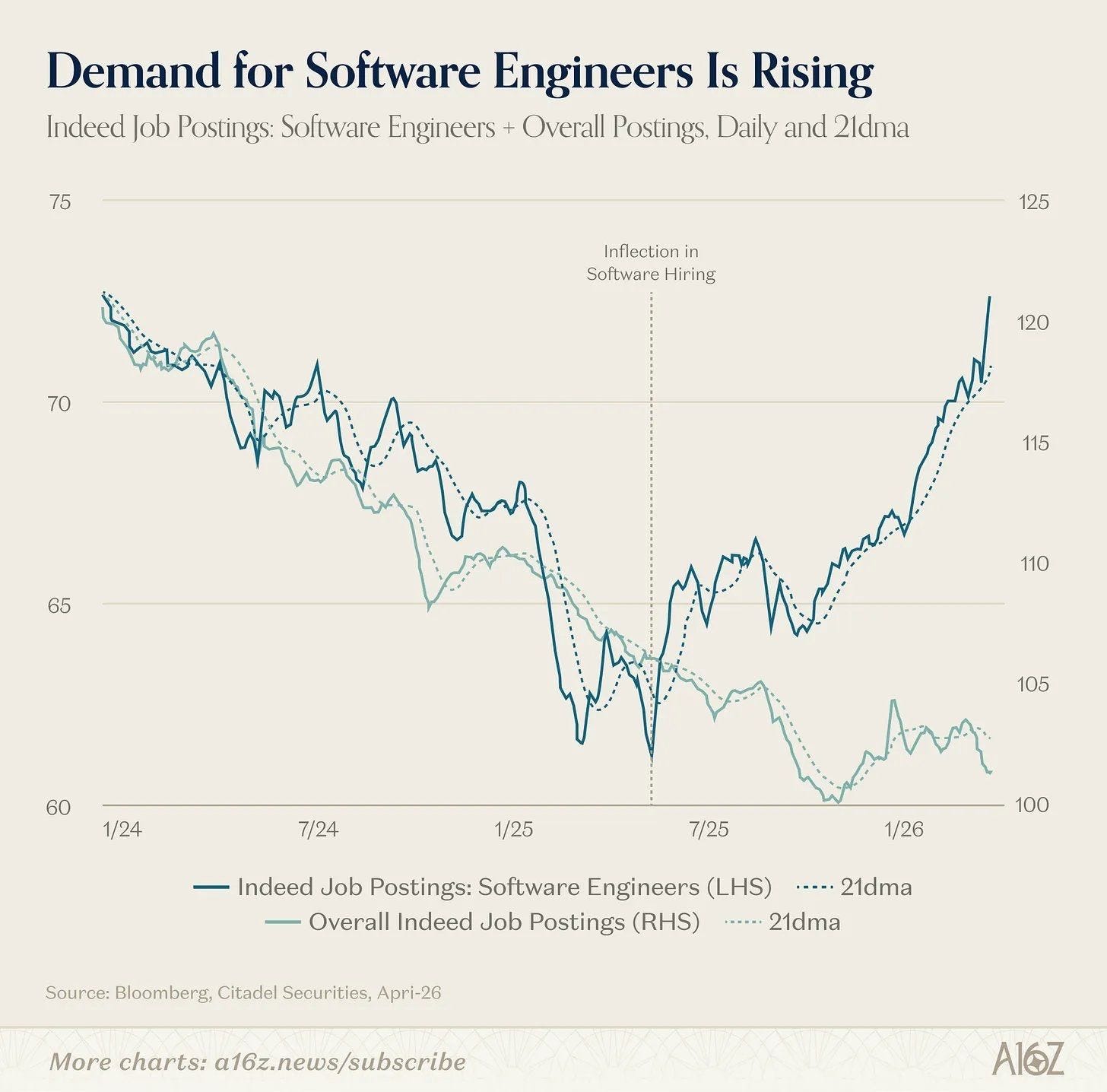
A new chart shared by David George from Andreessen Horowitz shows something that directly contradicts the dominant AI narrative: software engineering job postings are rising again, even as overall job postings stagnate. The data suggests that AI is not reducing demand for software engineers. Instead, it is changing what companies expect from them. As code generation becomes increasingly commoditised, the bottleneck is shifting toward understanding: business problems, operational constraints, industry workflows, and system behaviour. As I shared on LinkedIn last week, the era of the “generic software engineer”, the horizontal builder translating tickets into code, may be ending. In its place, two new profiles will emerge: horizontal specialists operating at the intersection of software and functions like product, finance, or sales; and vertical specialists deeply embedded in industries like healthcare, retail, or manufacturing.
The discussion around the post reinforced this shift. Several practitioners pointed out that writing code was never really the bottleneck, but that AI is now exposing the real one more clearly: architectural judgement and domain understanding. Others noted that many engineering organisations unintentionally trained developers to optimise tickets rather than outcomes, especially in heavily process-driven Agile environments. The result is that engineers who can connect technical decisions to business impact are becoming disproportionately valuable. The future likely belongs to smaller, more cross-functional teams where software engineers operate less like isolated executors and more like system thinkers embedded inside the business itself.
The new moat test

A growing number of software M&A discussions are now starting with the same question: “Why buy this company if we can rebuild it with AI?” A recent post from Sid Trivedi captured this shift bluntly, describing PE firms trying to recreate acquisition targets over a weekend with Claude Code before approving deals. From conversations I’ve had myself, this dynamic is no longer limited to private equity. Product-led acquisitions are increasingly challenged internally by boards and executives convinced that a small team equipped with modern coding agents can reproduce most software products quickly and cheaply. AI has undeniably reduced the cost of execution, making many software businesses feel less defensible than they did two years ago.
But the discussion around my LinkedIn post on the topic highlighted something many investors still underestimate: rebuilding software is not the same as understanding it. Several operators pointed out that what looks simple from the outside often hides years of accumulated decisions, failed approaches, edge cases, customer-specific workflows, and operational trade-offs. Others argued that the real moat was never just the code, but distribution, customer relationships, and execution. In reality, both are becoming true at the same time. AI is commoditising surface-level product replication, while increasing the value of deep system understanding and organisational execution. The companies hardest to replace will not necessarily be the ones with the most code, but the ones solving problems complex enough that reproducing the understanding behind the system becomes economically irrational.
Tech companies are starting to restructure around agents

Last week, both Coinbase and Cloudflare announced major layoffs explicitly tied to AI-driven organisational redesign. Coinbase is cutting roughly 14% of its workforce as Brian Armstrong argues that AI has fundamentally changed the economics of software delivery. In his memo, he described engineers shipping in days what previously took teams weeks, non-technical employees deploying production code, and a future organised around “AI-native pods” managing fleets of agents. The company is flattening management layers, increasing spans of control, and pushing leaders to operate as player-coaches rather than pure managers. Cloudflare announced a similar restructuring affecting more than 1,100 employees globally, explaining that internal AI usage had grown over 600% in just three months, with employees across engineering, HR, finance, and marketing now running thousands of agent sessions daily. Like Coinbase, Cloudflare framed the layoffs not as cost-cutting, but as a redesign of how a modern company operates in the “agentic AI era.”
What makes these announcements important is not the layoffs themselves, but the organisational model emerging underneath them. Both companies are converging toward the same structure: smaller, highly-contextual teams augmented by AI agents, fewer coordination layers, and employees expected to operate across broader scopes of responsibility. At the same time, these announcements reinforce a deeper industry shift: companies increasingly see dependency on large execution-heavy organisations as a strategic weakness. Whether these AI-native structures will actually outperform traditional organisations remains unclear. But the direction is becoming unmistakable: enterprises are no longer treating AI as a productivity tool layered on top of existing processes. They are beginning to redesign the organisation itself around agent orchestration rather than human execution.
The Changelog - Week of May 4th, 2026
Last week, 9 companies raised $2.49 billion in 4 countries, including $2 billion just for Asia-based Moonshot AI, the maker of Kimi coding model. Europe-based companies attracted 88% of total funding vs 12% for North America-based companies. One of these companies distribute or contribute to an open-source project. On the M&A side, 2 companies were acquired.
Funding Rounds
Moonshot AI, from Beijing 🇨🇳, raised $2 billion in Series D funding led by Long-Z Investment. Moonshot AI is a Chinese AI lab developing open-weight large language models through its Kimi series for consumer and enterprise applications. (more)
Blitzy, from Boston 🇺🇸, raised $200 million in Series A funding led by Northzone. Blitzy builds an autonomous enterprise software development platform that uses AI agents to generate and test code for legacy enterprise systems. (more)
DeepInfra, from Palo Alto 🇺🇸, raised $107 million in Series B funding led by 500 Global and Georges Harik. DeepInfra provides cloud infrastructure optimised for large-scale AI inference workloads and supports more than 190 open-source models. (more)
RadixArk, from San Francisco 🇺🇸, raised $100 million in Seed funding led by Accel and Spark Capital. RadixArk builds open AI infrastructure systems for training and deploying frontier models based on the open-source SGLang inference engine and Miles training toolkit. (more
Nova Intelligence, from New York 🇺🇸, raised $31.5 million in Series A funding led by Chemistry. Nova Intelligence develops an agentic AI platform that analyses and modernises SAP enterprise code for migrations and ongoing operations. (more)
CopilotKit, from Seattle 🇺🇸, raised $27 million in Series A funding led by Glilot Capital, NFX, and SignalFire. CopilotKit is an open-source platform that helps developers build and deploy AI agents inside applications using the AG-UI protocol. (more)
OpsMill, from Paris 🇫🇷, raised $14 million in Series A funding led by IRIS. OpsMill provides an infrastructure data management platform that structures IT data for AI-driven automation through its Infrahub system of record. (more)
LakeFusion, from Austin 🇺🇸, raised $7.5 million in Seed funding led by Silverton Partners. LakeFusion builds a Databricks-native AI-powered master data management platform for unifying and governing enterprise data. (more)
Boost Security, from Montreal 🇨🇦, raised $4 million in Seed extension funding led by White Star Capital. Boost Security develops an AI-native SDLC defence platform that identifies and remediates software vulnerabilities across the development lifecycle. (more)
M&A Rounds
Dremio, from Santa Clara 🇺🇸, was acquired by SAP. Dremio provides an open data lakehouse platform built on Apache Iceberg for high-performance analytics and agentic AI access to enterprise data. (more)
Prior Labs, from Berlin 🇩🇪, was acquired by SAP. Prior Labs develops tabular foundation models purpose-built for structured enterprise data and business outcome prediction. (more)