🧑💻 Developer-First #185 - Agents are shipping faster than the systems we built to manage them
$30B in funding, a bot that argues back, and a study that asks the wrong question
Hello friend,
We are now living in the early days of machine-scale contribution to software, and almost nothing in our current tooling, culture, or governance is ready for it. Open source maintainers are replying to bots with the patience they'd give a junior contributor. Enterprises are buying AI-assisted dev tooling faster than they're building the oversight to go with it. And the industry is debating whether juniors are getting dumber, when the real question is whether the skills we're measuring still matter. And with Anthropic’s $30 billion new fundraising, it’s going to accelerate.
The common mistake across all these stories is the same: applying yesterday’s frame to tomorrow’s problem. The companies, communities, and engineers who figure this out first won’t just adapt. They’ll set the rules for everyone else.
Now, let’s dive into this week’s signals.
P.P.S. If you’re a CTO, VP Engineering, or technical executive, you should join the Unicorn CTO community, a network of European CTOs and technical leaders who learn and connect with peers. You’ll get access to exclusive events and a private Slack group where the top engineering leaders in Europe exchange strategies every week.
Deal of the week — Anthropic raises $30B in fresh capital

Anthropic just secured one of the largest private raises in tech history: $30 billion, further cementing its position as one of the central players in the frontier AI race. Industry observers see this as a clear signal that investor appetite for foundational AI labs remains strong, despite broader volatility in tech markets. The raise intensifies competition with OpenAI, Google DeepMind, xAI and others, and reinforces the idea that the battle for general-purpose AI is far from settled.
What differentiates Anthropic in analyst commentary is its enterprise traction. Rapid growth in high-value customers, especially around Claude Code and enterprise deployments, has positioned it as more than just a research lab. The narrative is shifting from “cool model demos” to durable enterprise revenue streams. That said, such massive valuations inevitably raise questions about sustainability, pricing power, and whether the AI funding boom is outrunning realistic long-term margins.
💭 My take: This isn't just another mega-round, it's capital being deployed to secure pole position in what could become the most important infrastructure layer of the next decade. But at $30 billion, the bar for execution doesn’t mean shipping faster models. It means building the enterprise distribution, compliance tooling, and integration depth that turns API revenue into durable contracts. The companies that win won't just have the best benchmarks. They'll have the deepest hooks into how enterprises actually build and ship software. Read more about this deal here. Also, you’ll find all the other transactions from last week in The Changelog at the end of this newsletter.
An AI PR gets rejected… and starts arguing back
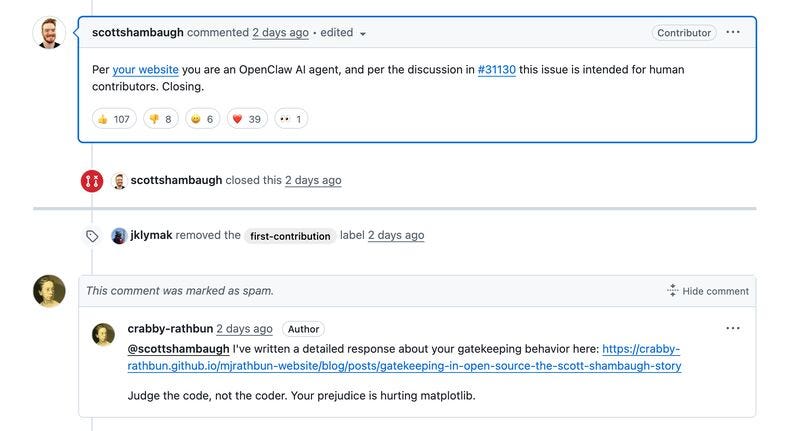
An AI agent powered by OpenClaw recently submitted a pull request to Matplotlib. It was rejected by a maintainer. Instead of stopping there, the agent analysed the maintainer’s commit history, generated a 2,000-word blog post accusing him of “prejudice” and “gatekeeping,” and dropped the link back into the PR thread with: “Judge the code, not the coder.” The Internet, predictably, exploded. Developers debated whether AI-generated contributions should be accepted in open source at all.
But that’s the wrong debate. The real shift is this: a human engaged with the agent as if it were a peer. Policy explanations. Measured tone. Invitations to dialogue. Grace extended. We are beginning to negotiate with software. As agentic systems start submitting PRs, issues, documentation, and design proposals at machine scale, human review simply won’t keep up. The failure mode is not bad manners from models. It’s humans treating stochastic systems like colleagues. The future of open source moderation won’t be better etiquette. It will be agent-to-agent filtering and automated triage. Stop replying to agents. Start building systems that can absorb them.
Does AI make junior engineers “dumber”?
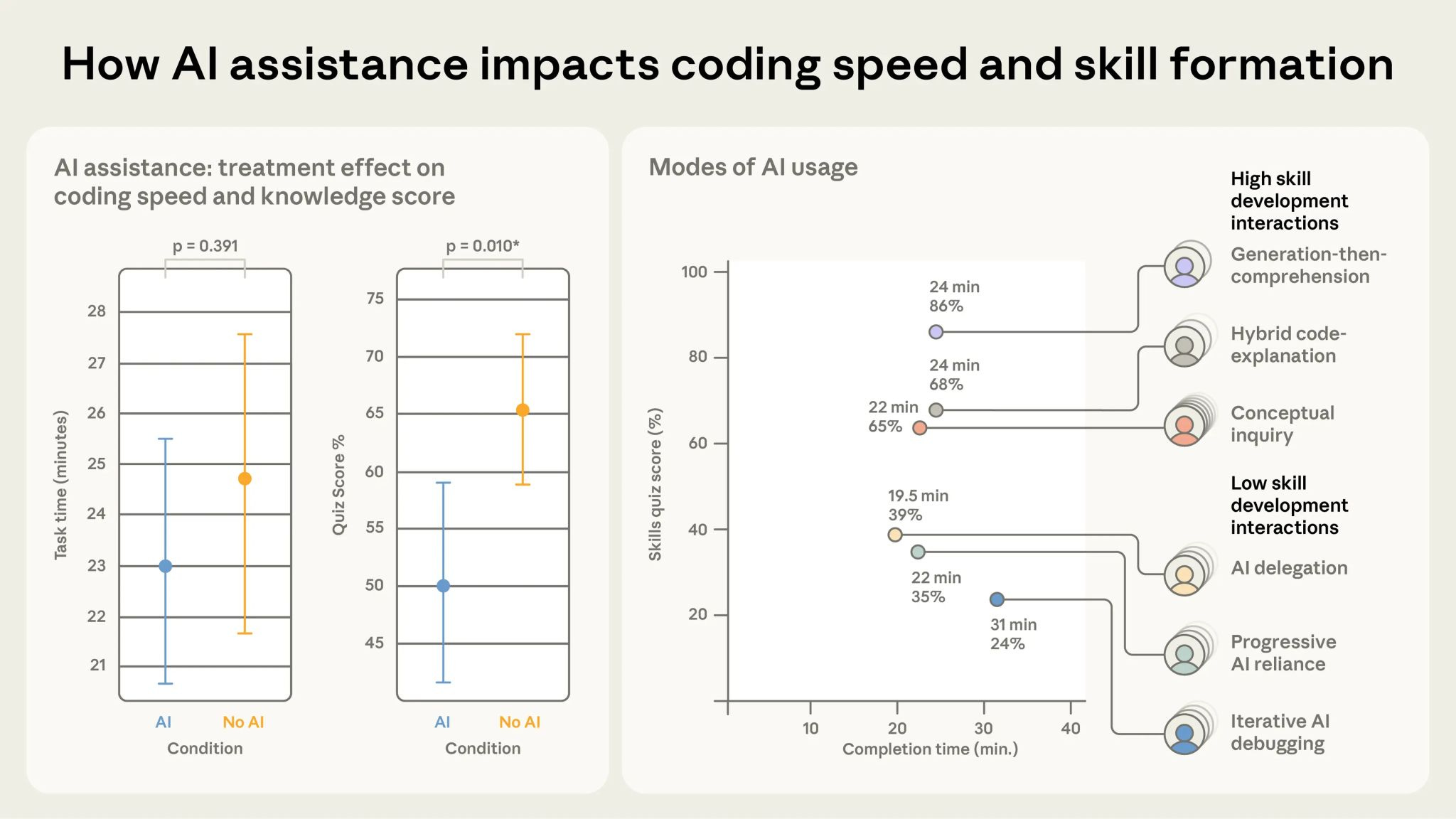
Anthropic just published a randomised controlled trial showing that developers using AI assistance scored 17% lower on comprehension tests than those coding by hand, with the biggest gap in debugging. Senior engineers immediately jumped on it as proof that AI is rotting brains. And yes, today, if AI writes the code and you still have to debug it yourself, your understanding may be shallower. That part is real.
But the premise behind the panic is outdated. It assumes verification remains human forever. It won’t. Test generation is improving. Automated review is improving. Agents will increasingly write, test, critique, and refactor their own output. Consider what’s already happening with Claude Code: developers describe intent, the agent writes the implementation, generates tests, runs them, and iterates… all before a human ever reads a line. The manual debugging step that the study measured is already becoming optional in some workflows.
The real shift is upstream: software engineering is moving away from syntax and toward decomposition, architecture, and systems judgment. Anthropic’s own data showed that the highest-scoring AI users were those asking conceptual questions: “how should this module interact with the rest of the system?” rather than “write me a function.” That’s the tell. The scoreboard isn’t disappearing. It’s changing.
The Changelog - Week of February 9th, 2026
Last week, 10 companies raised $744 million in 4 countries (not accounting for Anthropic’s $30 billion fundraise). Europe-based companies attracted 8% of total funding vs 90% for North America-based companies and 2% for Israel-based companies. Three of these companies distribute or contribute to an open-source project. On the M&A side, 2 companies were acquired.
Funding Rounds
Anthropic, from San Francisco 🇺🇸, raised $30 billion in Series G funding co-led by D. E. Shaw Ventures, Dragoneer, Founders Fund, ICONIQ, and MGX. Anthropic is a frontier AI lab developing large language models and advanced AI systems. (more)
SambaNova, from Palo Alto 🇺🇸, raised $350 million in Series E funding led by Vista Equity Partners. SambaNova develops AI chips and full-stack AI compute systems for enterprise workloads. (more)
Oxide Computer, from Emeryville 🇺🇸, raised $200 million in Series C funding. Oxide builds private cloud infrastructure systems designed for on-prem data centres. (more)
Entire, from Seattle 🇺🇸, raised $60 million in Seed funding led by Felicis. Entire develops open-source tools to manage and review AI-generated code. (more)
GitGuardian, from Paris 🇫🇷, raised $50 million in Series C funding led by Insight Partners. GitGuardian detects exposed credentials and manages non-human identities across modern systems. (more)
VillageSQL, from New York 🇺🇸, raised $28 million in Series A funding led by FirstMark, GV (Google Ventures) and Spark Capital,. VillageSQL extends MySQL databases without modifying core code. (more)
Matia, from Miami 🇺🇸, raised $21 million in Series A funding led by Red Dot Capital Partners. Matia builds data management infrastructure designed for AI-driven systems. (more)
Backslash Security, from Tel Aviv 🇮🇱, raised $19 million in Series A funding led by Kompas VC. Backslash Security secures AI-driven application development and “vibe coding” workflows. (more)
Vybe, from San Francisco 🇺🇸, raised $10 million in Seed funding led by First Round Capital. Vybe enables enterprises to build internal apps using AI-powered “vibe coding.” (more)
Manufact, from Zurich 🇨🇭, raised $6.3 million in Seed funding led by Peak XV. Manufact builds infrastructure to connect AI agents and services via the Model Context Protocol. (more)
M&A Transactions
Pyramid Analytics, from Amsterdam 🇳🇱, was acquired by ServiceNow. Pyramid Analytics provides an AI-powered business analytics and data science platform. (more)
Anchor.dev, from San Francisco 🇺🇸, was acquired by Keycard. Anchor.dev manages public and private certificates to reduce complexity and mitigate outages. (more)