🧑💻 Developer-First #183 - When code stops being the moat
Why distribution, context, and responsibility are reshaping software and AI
Hello friend,
This week’s edition sits right at the intersection of a shift many of us can feel, but few are fully ready to internalise yet. Earlier this week I shared a post on LinkedIn that sparked a lot of debate: in a world where implementation speed has collapsed and replication costs are close to zero, technological moats as we used to define them are fading fast. Code is cheap now. What’s scarce has moved elsewhere: distribution, accumulated context, and responsibility.
You’ll see that theme echoed across the two stories in this issue. Cursor’s experiment building a full web browser autonomously shows how fast raw implementation is becoming commoditised, and why orchestration, workflows, and interfaces are the real control points. And Avenir’s take on the future of SaaS makes it clear that software businesses are being reshaped less by features and more by who owns the customer relationship, the data exhaust, and the operational burden.
Put together, these stories point to the same uncomfortable conclusion: the moat has not disappeared, but it has moved. Away from code, toward distribution, lived-in systems, and the willingness to take responsibility when AI-driven software inevitably breaks.
Now, let’s dive into this week’s signals.
P.P.S. If you’re a CTO, VP Engineering, or technical executive, you should join the Unicorn CTO community, a network of European CTOs and technical leaders who learn and connect with peers. You’ll get access to exclusive events and a private Slack group where the top engineering leaders in Europe exchange strategies every week.
Deal of the week — Inferact raises $150M to commercialise vLLM
The creators of vLLM, one of the most widely used open-source LLM inference engines, have officially spun it out into a company called Inferact, raising a massive $150M seed round at an $800M valuation. The round was co-led by Andreessen Horowitz and Lightspeed, with the company positioning itself as the neutral, open backbone for AI inference as the industry shifts from training to production. vLLM is already deeply embedded in real-world deployments, including usage by hyperscalers and high-scale consumer applications.
The timing is not accidental. As models grow larger, more multimodal, more agentic, and more hardware-dependent, inference has quietly become the dominant cost and complexity bottleneck in AI systems. Tools like vLLM and SGLang, both incubated at UC Berkeley under Ion Stoica, sit exactly at the intersection of model architectures and hardware execution.
💭 My take: This is a textbook example of where AI value is consolidating. Training gets the headlines, but inference is where money, lock-in, and leverage accumulate. The fact that open-source inference engines are now being valued in the hundreds of millions at seed stage tells you everything: the control plane of AI is moving down the stack, and whoever owns inference will quietly own the economics of AI at scale. Read more about this deal here. Also, you’ll find all the other transactions from last week in The Changelog at the end of this newsletter.
Scaling long-running autonomous coding
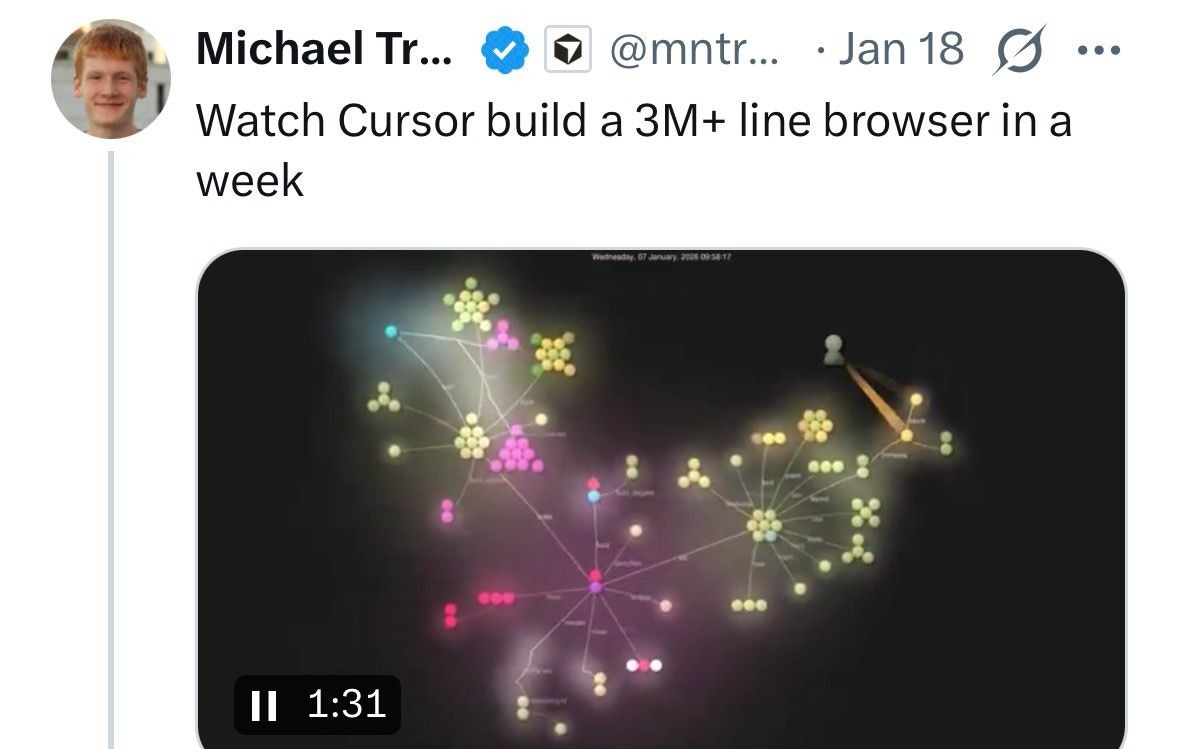
Cursor just ran an experiment most teams still consider reckless: they let GPT-5.2 build a full web browser autonomously for an entire week. No pauses. No human steering. The result was more than 3 million lines of code across thousands of files. This wasn’t a flashy demo or a weekend hack. It was a stress test of what happens when you stop thinking about AI agents in minutes and start designing for weeks of uninterrupted execution.
What’s striking is how unglamorous the breakthrough was. One agent doesn’t scale, it just trips over itself. Cursor moved to parallelism, hundreds of agents on one codebase, and immediately hit coordination failures that felt very human. The solution wasn’t smarter models or heavier control systems, but structure. Clear roles. Planners to explore and decompose work. Workers to execute and push code without context switching. A judge to decide whether the system keeps going. With that setup, agents didn’t just generate code, they shipped: full products, large migrations, production rewrites with real performance gains. This is happening much faster than anyone predicted. Software is no longer about humans writing code faster, it’s about designing systems where code writes itself continuously. Once you see that, it becomes obvious this is not a tooling story, it’s a structural shift in how software companies will be built.
The Future of SaaS: a fork in the road
Avenir Ventures’ latest 46-page deck makes one thing painfully clear: SaaS is no longer in a simple cyclical slowdown, it has hit structural maturity. Public SaaS growth has stabilised at much lower levels, multiples have compressed back to pre-ZIRP norms, IPOs remain frozen, and despite years of “Rule of 40” discipline, true profitability is still elusive for the median company . Horizontal SaaS has been hit especially hard, while vertical and cyber-native platforms show relative resilience. In short, the old playbook of land, expand, and wait for multiple expansion is broken.
The real battle Avenir highlights is not about growth rates, but about what SaaS becomes next. Vendors face a binary choice: accept maturity and financialise into slower, cash-yielding software businesses, or fully embrace AI and evolve into “systems of context” that own workflows, data, and decision loops end to end. This explains why strategic M&A remains robust even as public markets punish SaaS stocks. Buyers are not paying for ARR alone anymore, they are paying for control points in the stack. In an AI-first world, SaaS that stays a thin UI over commoditized infrastructure will struggle, while platforms that become the operating layer for agents, automation, and real-time decisions will define the next cycle.
The Changelog - Week of January 19th, 2025
Last week, 12 companies raised $1.13 billion in 4 countries. Europe-based companies attracted 0.4% of total funding vs 98.7% for North America-based companies and 0.9% for Asia-based companies. Two of these companies distribute or contribute to an open-source project. On the M&A side, 0 companies were acquired.
Funding Rounds
humans&, from San Francisco 🇺🇸 raised $480 million in Seed funding. humans& is a human-centric AI research lab founded by alumni from Anthropic, xAI, and Google, focused on building aligned and interpretable AI systems. (more)
Baseten, from San Francisco 🇺🇸 raised $300 million in Series D funding led by IVP and CapitalG. Baseten provides an AI infrastructure platform offering the tooling, expertise, and compute needed to bring AI products to market quickly and efficiently. (more)
Upscale AI, from Palo Alto 🇺🇸 raised $200 million in Series A funding led by Tiger Global, Premji Invest, and Xora Innovation. Upscale AI integrates GPUs, memory, storage, and networking into unified AI infrastructure for hyperscale compute performance. (more)
Inferact, from San Francisco 🇺🇸 raised $150 million in Seed funding led by Andreessen Horowitz and Lightspeed Venture Partners. Inferact builds infrastructure powered by open-source vLLM to run large language models more efficiently at scale. (more)
Railway, from San Francisco 🇺🇸 raised $100 million in Series B funding led by TQ Ventures. Railway is a cloud platform that simplifies deploying and running applications for developers. (more)
LiveKit, from San Jose 🇺🇸 raised $100 million in Series C funding led by Index Ventures. LiveKit is a developer platform for building real-time voice, video, and physical AI agents. (more)
Emergent, from San Francisco 🇺🇸 raised $70 million in Series B funding led by SoftBank Vision Fund 2 and Khosla Ventures. Emergent offers an AI platform to design, build, test, and deploy web and mobile applications using natural language interfaces. (more)
Artie Technologies, from San Francisco 🇺🇸 raised $12 million in Series A funding led by Standard Capital. Artie offers a fully managed real-time streaming platform for deploying AI, operational, and customer-facing analytics applications. (more)
Symbiotic Security, from New York 🇺🇸 raised $10 million in Seed funding led by Alven. Symbiotic Security enforces security constraints during AI code generation, preventing vulnerabilities before they reach production. (more)
Bolna, from Bengaluru 🇮🇳 raised $6.3 million in Seed funding led by General Catalyst. Bolna provides an orchestration layer for building and running AI voice agents tailored for Indian enterprises. (more)
Stilla, from Stockholm 🇸🇪 raised $5 million in Pre-Seed funding led by General Catalyst. Stilla shares real-time product context across tools like Slack, GitHub, Linear, and Notion to improve team collaboration in AI-driven organisations. (more)
Dam Secure, from Sydney 🇦🇺 raised $4 million in Seed funding led by Paladin Capital Group. Dam Secure is an AI-native security platform designed to detect and prevent logic flaws in AI-generated code. (more)
Excellent analysis! This realy resonates with me as an AI enthusiast. It makes me wonder, how do you see this shift impacting the future of tech education, especially focusing on new moats like distribution and responsibility? So thought-provoking!