🧑💻 Developer-First #175 - The Next Frontier of AI-Generated Code
AI isn’t just writing code faster; it’s redefining how software gets built.

Hello friend,
This week, two signals stood out that capture where software is heading. First, Inception raised a $50 million seed round to build diffusion models for code, a bold bet that the next generation of AI won’t just write text but reason over entire codebases with lower latency and cost. Then, GitHub’s Octoverse 2025 confirmed that transformation is already underway: 80% of new developers now use Copilot in their first week, and TypeScript has overtaken Python and JavaScript as the most used language, driven by the rise of typed, AI-assisted development.
No matter where you stand on AI-generated code, it’s clear that it’s not a fad. AI-assisted development has crossed the adoption threshold, and it’s already changing how teams write, review, and reason about code. The shift isn’t just about speed or productivity; it’s about abstraction. Developers are moving one layer up, from writing code to orchestrating agents, workflows, and systems that code for them.
What we’re seeing today is only the tip of the iceberg. The next wave won’t just automate code generation, it will redefine what it means to “develop software,” blending human intent, model reasoning, and organisational knowledge into a single, intelligent development loop.
P.S. If you’re a CTO, VP Engineering, or technical executive, you should join the Unicorn CTO community, a network of European tech leaders who learn and connect with peers. You’ll get access to exclusive events and a private Slack group where the top engineering leaders in Europe exchange strategies every week.
P.P.S.: I’m doing a live AMA with Unicorn CTO member Felipe Huici (CEO at Unikraft) on sandboxing, AI’s infra footprint, and why the cloud is fundamentally broken. Register here to attend.
Deal of the Week — Inception’s $50M seed round
Inception, founded by Stanford professor Stefano Ermon, has raised $50 million in seed funding led by Menlo Ventures. The company is pioneering diffusion-based AI models for code and text, a structural shift away from the autoregressive architecture used by GPT-style models. Its first product, the Mercury model, is already integrated into dev tools like ProxyAI, Buildglare, and Kilo Code.
While most text-generation models work word-by-word, Inception’s diffusion models refine entire responses iteratively, offering faster, cheaper, and potentially more scalable inference for large codebases. If they can maintain accuracy while reducing latency and compute cost, diffusion-based LLMs could redefine what “real-time” code generation means for developers and enterprises
💭 My take: This round isn’t just another big AI seed, it’s a signal that the next AI frontier may come from outside the autoregressive paradigm. Read more about this deal here. Also, you’ll find all the other transactions from last week in The Changelog at the end of this newsletter.
2025 State of B2B GTM Report
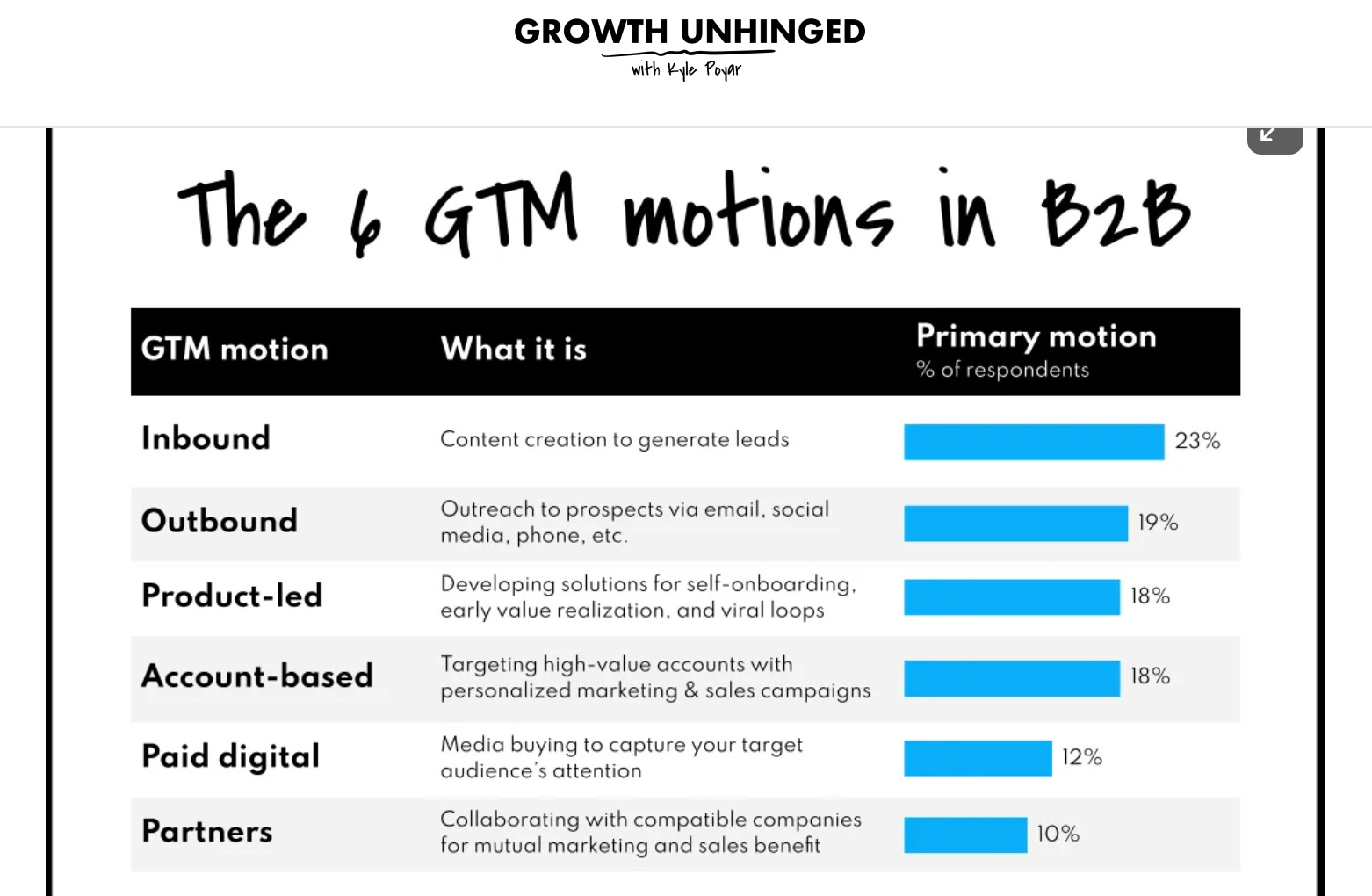
I went through Kyle Poyar’s 2025 State of B2B GTM Report to see which findings apply when selling to CTOs and technical buyers. What I learned is that most GTM motions still work, but only when they’re tailored to your audience and ACV. Inbound builds credibility, outbound builds relationships, and ABM scales what already resonates. For developer-first or infra products, that means a flow of educate → capture usage → expand into strategic accounts. But the biggest trap founders fall into is spreading too thin as the average startup runs five channels and five experiments. For technical buyers who value signal over noise, that’s fatal. Focus on 2–3 scalable motions that align with how CTOs actually buy: founder-led content, warm outbound, and tight-knit community events.
The report also highlights that founder-led GTM still converts 3–5× better in technical markets, because credibility trumps automation. Engineers want to talk to the person who built the thing, not a polished SDR. Keep that personal touch until your story is repeatable, then scale with Account Executives or evangelists who speak “CTO.” And while AI now powers GTM research and personalisation, it’s not a replacement for authentic technical dialogue. As Poyar puts it, storytelling beats tooling: the best GTM motion is still a clear, data-backed narrative that makes a CTO nod.
Inside GitHub’s 2025 Octoverse
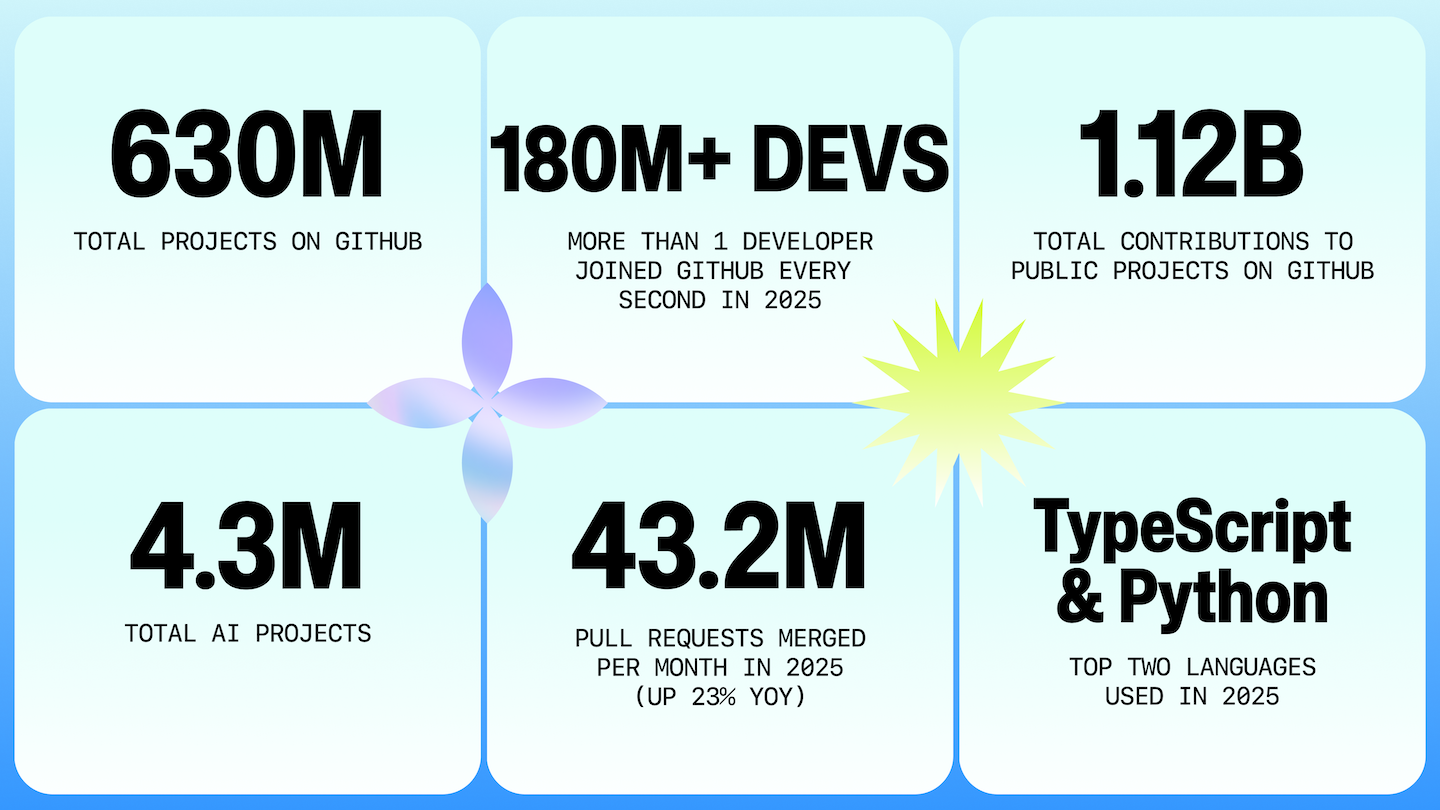
GitHub’s Octoverse 2025 paints a clear picture of where software is heading: AI, agents, and typed languages are rewriting the rules of development. With one new developer joining GitHub every second, the platform now hosts 180 million developers, who created 230 new repositories per minute and pushed nearly 1 billion commits this year. Much of this surge came after Copilot Free launched, lowering the barrier for new entrants: 80% of new developers now use Copilot in their first week. India alone added over 5 million developers in 2025, surpassing the U.S. as the largest contributor base to open source and signalling a permanent shift in the global developer power map.
The biggest structural change, however, is TypeScript overtaking both Python and JavaScript to become the most used language on GitHub, a direct byproduct of AI-assisted coding. Typed languages give models and agents the context they need to reason more safely in production, which is why nearly every major framework now scaffolds in TypeScript by default. This year’s Octoverse confirms two things: AI is no longer an add-on, and open source remains its beating heart. As the report puts it, the story isn’t AI versus developers, it’s developers evolving to orchestrate AI.
The Changelog - Week of November 3rd, 2025
Last week, 6 companies raised $146 million across 5 product categories in 3 countries. Europe-based companies attracted 7% of the total funding vs 76% for North America-based companies and another 17% for Asia-based companies (incl. Israel). Just one of these companies distribute or contribute to an open-source project. On the M&A side, two companies were acquired.
Funding Rounds
Inception, from Palo Alto 🇺🇸 raised $50 million in Seed funding led by Menlo Ventures. Inception’s founders pioneered diffusion modelling and key AI innovations such as Flash Attention and Decision Transformers, now applying diffusion models to discrete data like text and code. (more)
DualBird, from Tel Aviv 🇮🇱 raised $25 million in Series A funding led by Lightspeed Venture Partners. DualBird has built a cloud-native data engine that fuses hardware and software for 10–100× faster performance and 50–90% cost savings without infrastructure overhaul. (more)
Teleskope, from New York 🇺🇸 raised $25 million in Series A funding led by M13. Teleskope offers an agentic data security platform that autonomously scans, classifies, and remediates data risks across an organisation to safely enable AI adoption. (more)
AUI, from New York 🇺🇸 raised $20 million in Seed funding from eGateway Ventures and New Era Capital Partners. AUI is developing Apollo-1, a foundation model for task-oriented dialogue powered by stateful neuro-symbolic reasoning. (more)
Parable, from New York 🇺🇸 raised $16.5 million in Seed funding led by HOF Capital. Parable builds operational measurement infrastructure that aggregates workplace data and applies AI to uncover hidden organisational patterns and performance drivers. (more)
Tsuga, from Paris 🇫🇷 raised $10 million in Seed funding led by General Catalyst. Tsuga offers a new generation observability platform based on a Bring-Your-Own-Cloud model, giving engineering teams control over cost, scalability, and data sovereignty. (more)
M&A Transactions
SPLX, from New York 🇺🇸 (and originally from Croatia 🇭🇷) was acquired by Zscaler. SPLX provides an AI security platform that protects LLM-powered systems throughout their lifecycle, helping Fortune 500 companies adopt AI safely and securely. (more)
Marimo, from San Francisco 🇺🇸 was acquired by CoreWeave. Marimo builds open-source Python tools for machine learning and data science, including its flagship interactive notebook for exploration, tool-building, and app deployment. (more)
This article comes at the perfect time, making me wonder if this abstraction in AI-assisted development wil necessitate a complete re-evaluation of our tech education policies.