🧑💻 Developer-First #168 - CAC and LTV metrics don't tell the full story
Investors now scrutinise more and more ARR per Customer and ARR per Sales Rep

Hello friend,
When investors analyse a post–Series A startup, they are paying increasing attention to ARR per customer and the ARR generated by each sales rep.
Why? Because standard metrics like CAC or LTV averages can create a false sense of comfort. One large outlier deal or unusually low churn can easily mask deeper structural issues. By contrast, metrics such as average ARR per customer or new ARR per account executive often expose a poorly calibrated market positioning, or sales productivity far below accepted benchmarks.
This matters because while European startups excel in technology, they consistently fall into two traps when scaling their commercial engines:
1️⃣ Selling too fast to large enterprises.
Sales cycles stretch to nine months, teams drown in endless POCs, and closed deals end up worth less than €50k in annual revenue. The result: ARPA that is too low, roadmaps skewed toward the demands of a few large accounts, and burn rates that spiral.
2️⃣ Over-staffing the sales team.
Instead of diagnosing low productivity per rep, many startups simply hire more salespeople. This creates bloated teams that cost a lot and deliver little—something investors spot immediately during due diligence.
That is why ARR per customer and new ARR per sales rep are becoming central to the way investors judge scaling startups. These metrics reveal whether you are selling into the right market segment, whether your pricing is appropriate, and whether your sales team is genuinely productive.
For founders preparing to raise their next round, the lesson is simple: face these numbers before investors do. They speak volumes about the true health and scalability of your growth model.
Deal of the week - Atlassian acquires DX for $1 billion

Atlassian is making its biggest bet yet on developer productivity with the acquisition of DX, a platform that helps enterprises measure engineering effectiveness and spot bottlenecks. Founded in 2019, DX has tripled its customer base every year, now serving 350+ enterprises, all while raising less than $5 million in venture funding.
It’s Atlassian’s third deal this month after acquiring The Browser Company for $610 million and French product feedback platform Cycle. Together, these moves show a clear strategy: consolidating AI-driven tools and developer productivity platforms into a unified product suite.
Read more about this deal here. Also, you’ll find all the other funding rounds and acquisitions from last week in The Changelog at the end of this newsletter.
Market pulse - Netskope soars on Nasdaq debut
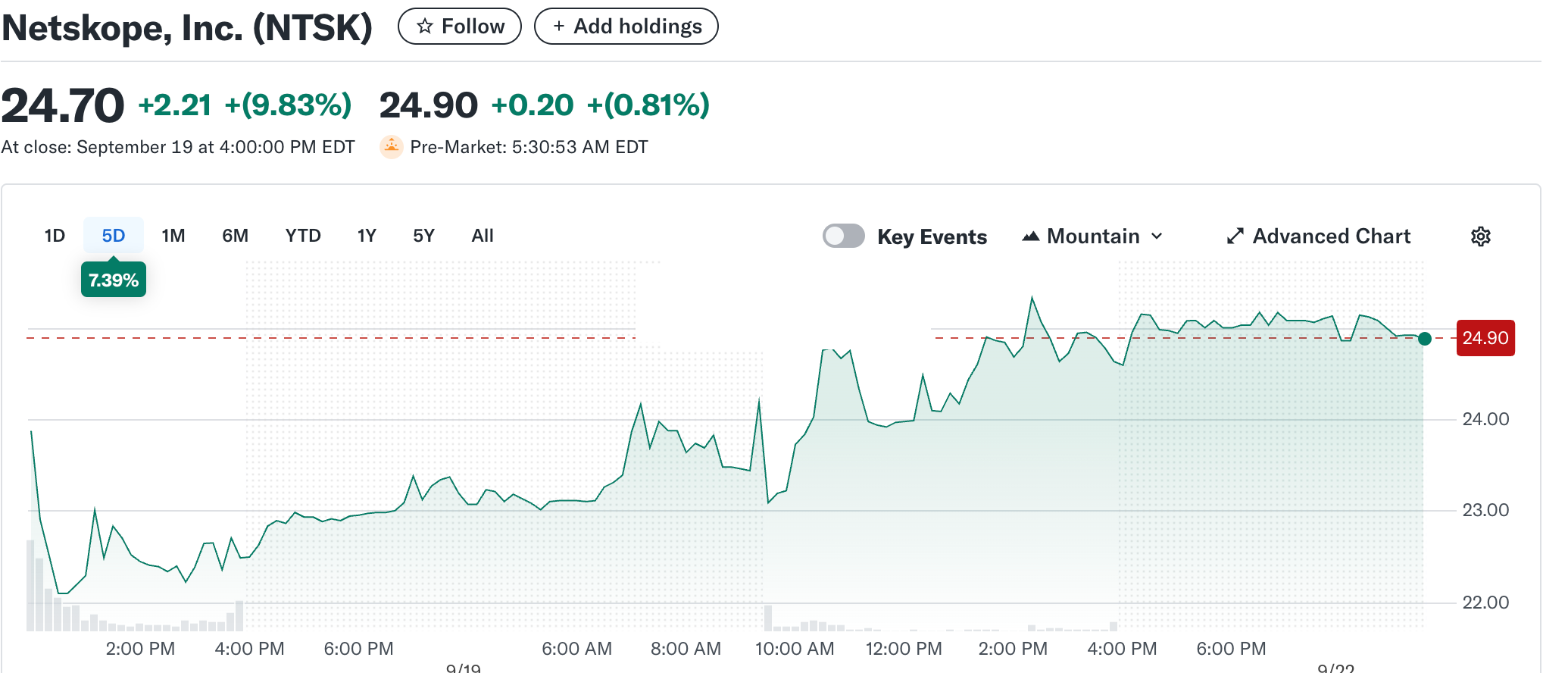
Cybersecurity firm Netskope surged 18% on its first day of trading, closing with an $8.6 billion market cap. Shares priced at $19 — the top of its range — and ended Thursday at $23, after an IPO that was more than 20x oversubscribed and raised $908 million. CEO Sanjay Beri framed Netskope’s positioning squarely at the intersection of AI and cloud security, calling it a redefinition of “the biggest market in security, data network security.”
Beyond Netskope itself, the listing marks another sign of the IPO market’s reopening after a two-year drought, with investors again willing to pay a premium for growth stories tied to AI-driven demand.
Signal vs Noise - Chinese open-source models are the new default for AI startups
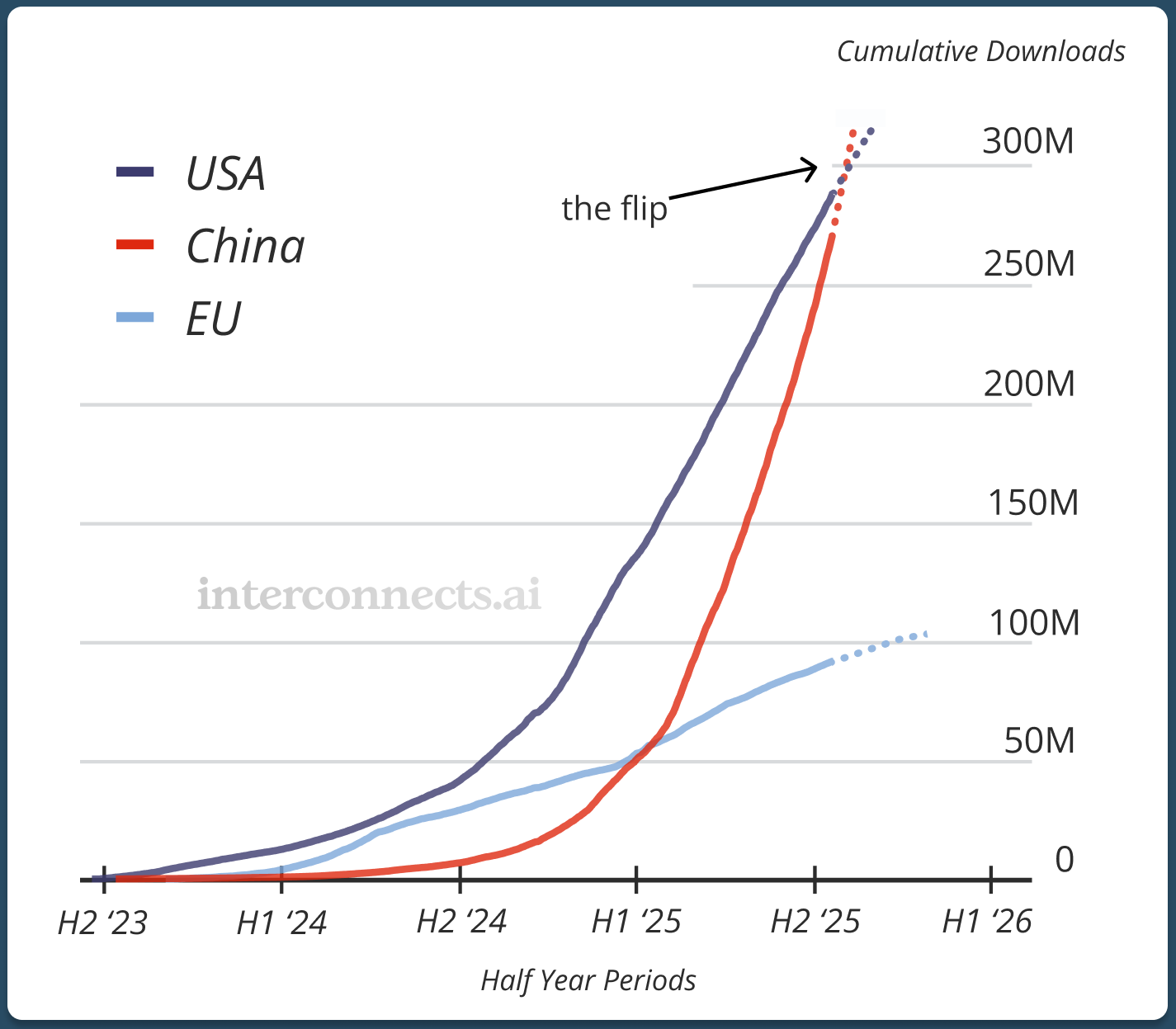
Last week, Alibaba-NLP/DeepResearch was the #1 trending GitHub project, underscoring the momentum of Chinese contributions. Data from Hugging Face (see chart above, via Nathan Lambert) shows the “flip” is happening now: cumulative downloads of Chinese open models are overtaking those from the US. While the American ecosystem has plateaued, China’s is accelerating (read more here).
Even leading VCs are acknowledging the shift. As a16z partner Martin Casado recently told The Economist: “I’d say 80% chance [our portfolio companies are] using a Chinese open-source model.” For Europe, the risk is obvious: caught between US stagnation and China’s acceleration, the region must decide whether to lean on Chinese defaults or double down on its own sovereign alternatives.
The Changelog - Week of September 15th, 2025
Last week, 14 companies raised $1.29 billion across 6 product categories in 3 countries. North America-based companies attracted 87% of the total funding vs 12% for Asia-based companies (Israel only) and 1% for Europe-based companies. Two companies distribute or contribute to an open-source project. On the M&A side, 3 companies were acquired.
Funding Rounds
Groq, from Mountain View 🇺🇸 raised $750 million in Late VC funding led by Disruptive. Groq delivers high-speed, energy-efficient AI inference with its LPU™ technology, powering large-scale cloud and on-prem applications. (more)
Upscale AI, from Saratoga 🇺🇸 raised $100 million in Seed funding co-led by Mayfield Fund and Maverick Silicon. Upscale AI provides scalable open AI backend networks tailored for high-performance workloads. (more)
Airia, from Atlanta 🇺🇸 raised $100 million in Seed funding from its founder, John Marshall. Airia delivers an enterprise AI orchestration platform to securely build, deploy, and manage AI agents at scale. (more)
Irregular, from Tel Aviv 🇮🇱 raised $80 million in Series A funding led by Sequoia Capital. Irregular builds frontier security defences to uncover vulnerabilities and secure advanced AI systems before release. (more)
Vega, from Tel Aviv 🇮🇱 raised $65 million in Series A funding led by Accel. Vega provides full SecOps coverage with powerful tools for search, detection, investigation, and response. (more)
CodeRabbit, from Walnut Creek 🇺🇸 raised $60 million in Series B funding led by Scale Venture Partners. CodeRabbit enhances code review with detailed line-by-line AI suggestions and conversational Q&A. (more)
RegScale, from Tysons 🇺🇸 raised $30 million in Series B funding led by Washington Harbour Partners. RegScale offers continuous controls monitoring to improve security, risk, and compliance outcomes. (more)
Macroscope, from San Francisco 🇺🇸 raised $30 million in Series A funding led by Lightspeed Venture Partners. Macroscope gives teams real-time insights into their codebase, automates reviews, and powers engineering decisions directly from code. (more)
Ultralytics, from Arlington 🇺🇸 raised $30 million in Series A funding led by Elephant. Ultralytics, the creator of YOLO, delivers open-source, real-time computer vision frameworks used by millions worldwide. (more)
MetalBear, from Tel Aviv 🇮🇱 raised $12.5 million in Seed funding led by TLV Partners. MetalBear, creator of mirrord, lets developers run local code directly inside Kubernetes clusters without deployment. (more)
Blacksmith, from San Francisco 🇺🇸 raised $10 million in Series A funding led by GV. Blacksmith cuts GitHub Actions runtime in half while reducing costs for engineering teams. (more)
Plumerai, from London 🇬🇧 raised $8.7 million in Series A funding led by Partech and OTB Ventures. Plumerai develops tiny AI for embedded devices, powering millions of smart cameras and IoT applications. (more)
Overmind, from London 🇬🇧 raised $6 million in Seed funding led by Renegade Partners. Overmind helps engineering teams predict the impact of infrastructure changes to prevent outages and speed reviews. (more)
Vibranium Labs, from New York 🇺🇸 raised $4.6 million in Seed funding co-led by Calibrate Ventures and Mirae Asset. Vibranium Labs equips SREs with Agentic AI to detect, triage, and resolve incidents proactively, reducing downtime and strengthening reliability. (more)
M&A Transactions
DX, from Salt Lake City 🇺🇸 was acquired by Atlassian for $1 billion. DX provides an engineering intelligence platform giving leaders data to boost developer productivity. (more)
Lakera, from Zurich 🇨🇭 was acquired by Check Point Software for $300 million. Lakera offers real-time AI security, including its Gandalf platform, used by over a million users to learn about AI risks. (more)
Pangea, from Palo Alto 🇺🇸 was acquired by CrowdStrike for $260 million. Pangea’s AI security platform protects against LLM risks and accelerates secure AI adoption across enterprises. (more)